Tap Water in Sardinia — A Local's Honest Guide for Olbia (2026)
Yes, it's safe. But we don't drink it ourselves — here's why, and why it's still bottled water on every RENTAL12 kitchen counter.
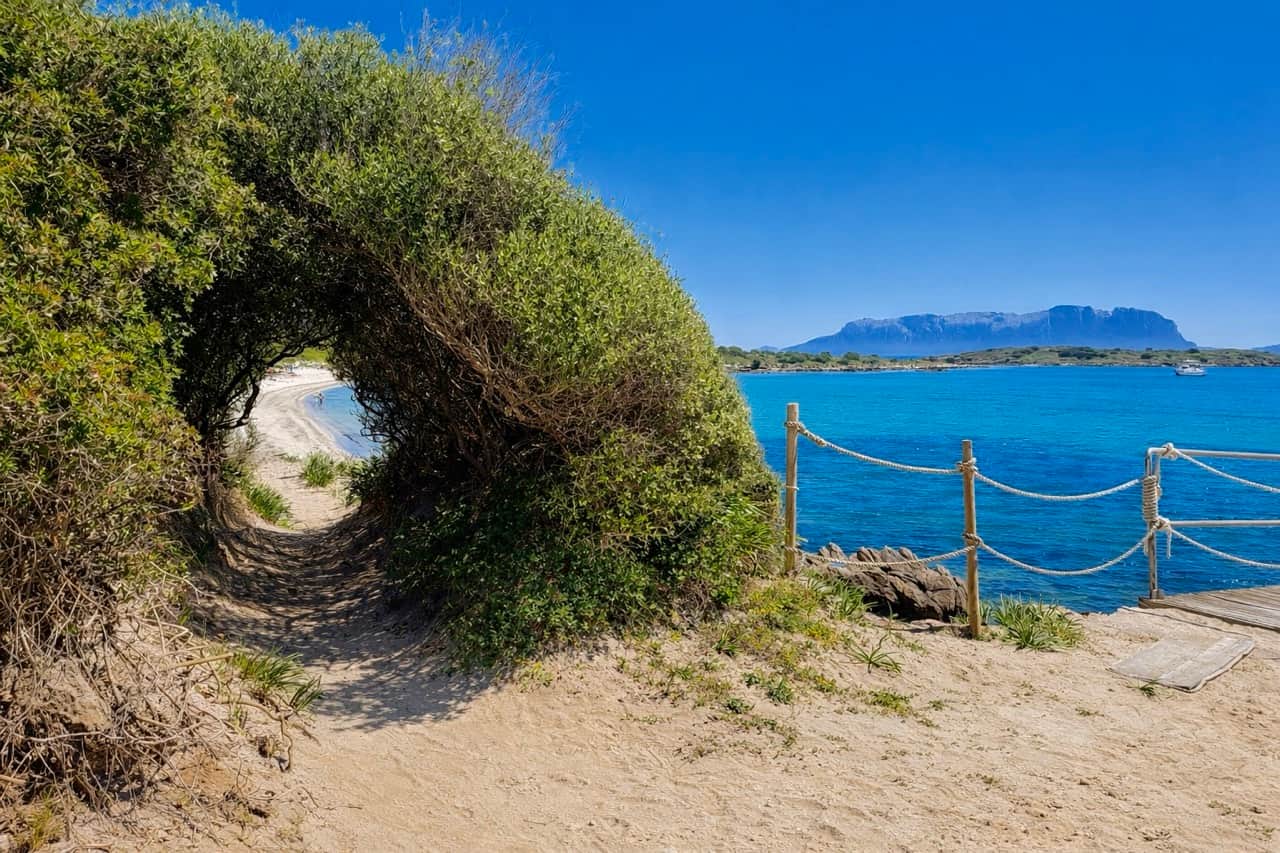
Pittulongu, 8 km north of Olbia. The Liscia mountain catchment that feeds the city's tap water lies inland from this coastline. Photo by RENTAL12.
Quick Guide — The 60-Second Answer
Yes, tap water in Sardinia is safe — but we (RENTAL12 owner-operators) don't drink it ourselves. Olbia tap is potable under EU Directive 2020/2184 and Italian Decree 31/2001, monitored by Abbanoa and ASL Gallura. The source is the Liscia aqueduct (a Gallura mountain reservoir that also serves Pittulongu, Porto Istana, Murta Maria, San Teodoro, and Golfo Aranci) — quality is high at the source. The pipes are why we still buy bottled: Sardinia loses 53–60% of piped water to leaks (ISTAT, 2nd worst in Italy); Olbia has roughly 8–12 documented mains interruptions per year (you'll see Abbanoa autobotti water trucks parked at neighbourhood corners during them); and after a maintenance event the tap can pour visible sediment or "earth" for the first 30 seconds. Bottled water is the default drinking source in every RENTAL12 apartment — because that is what we keep on our own kitchen tables. The premium AZULIS tier adds a private water reserve tank with a multi-stage carbon filter on the tank inlet — AZULIS guests can drink straight from the tap because the stored water is polished. The water is safe. We just prefer bottled. Your call.
Live tools for your Olbia stay
Real-time helpers that update every day with Sardinia conditions.
Is Tap Water in Sardinia Safe to Drink?
Quick answer: Yes — tap water in Sardinia is safe to drink. It is potable across the regional network, tested daily by Abbanoa (the regional public water utility) and the regional health authority (ASL), and it complies with the EU Drinking Water Directive 2020/2184 and Italian Decree 31/2001. It is also true that we (RENTAL12 owner-operators) do not drink it ourselves — and that personal preference is what shapes how we host. Two things can be true at once: the water is safe, and bottled is what is on our own kitchen counter.
The Italian standard for drinking water is one of the strictest in Europe. The legal limits for chemical contaminants, microbiology, turbidity, and chlorine are codified in Decreto Legislativo 31/2001, recently aligned with the EU Drinking Water Directive 2020/2184 (in force from 12 January 2023). Abbanoa is required to publish the chemistry and microbiology of every Sardinian aqueduct, and the regional health authority audits independently. When something falls outside the limits — even by a fraction — the local mayor issues a "non-potabile" ordinance and the affected zone gets bottled water until the issue is fixed.
For travellers who have been told "Italian tap water is fine but Sardinian tap water isn't" — that is folklore. Sardinian tap water is held to the same legal standard as Milan's or Rome's. The difference is what happens between the regulator's last test and your kitchen tap. We (RENTAL12 hosts) buy mineral water at the supermarket in 1.5L cases every week — that is a personal preference, not a recommendation against the tap. Italy is Europe's largest per-capita bottled-water consumer; we are a fairly typical Italian household in that regard.
What About Olbia Specifically?
Quick answer: Olbia's tap water comes from the Liscia aqueduct — a Gallura mountain reservoir fed by the Liscia river. The same supply line serves Pittulongu, Murta Maria, Porto Istana, Berchideddu, Golfo Aranci, and San Teodoro. Source-water quality is high. The historic city centre and old town have not had a non-potabile ordinance in living memory; three peripheral subfractions had brief ones in August 2022 (all resolved within weeks).
The Liscia aqueduct is the modern lifeline. It draws from Lake Liscia (Gallura's main reservoir, on the Liscia river in the granite hills behind Arzachena), passes through treatment, and arrives via underground main into central Olbia, then branches out to Pittulongu, Murta Maria, Porto Istana, Berchideddu, plus Loiri Porto San Paolo, Golfo Aranci, Padru, Monti, and San Teodoro. The city of Olbia also hosts a UNESCO-noted Roman aqueduct (II–III century AD) at Sa Rughittula — historic curiosity, not in active use.
In August 2022, three short non-potabile ordinances were issued in Olbia, all in peripheral subfractions:
- Sa Castanza — turbidity parameter exceeded (sediment, not pathogens)
- Trainu Moltu — total coliforms and E. coli above limits
- Mamusi — total coliforms and E. coli above limits
Source: Comune di Olbia ordinances August 2022 (Mayor Settimo Nizzi). All three ordinances were lifted once Abbanoa flushed the affected stretches and follow-up sampling came back compliant. Olbia city centre, the old town, and our 34 RENTAL12 apartments were not affected.
The pattern is informative. Issues in Olbia have historically been at the periphery of the network — at the dead-ends of long-stretch service pipes, often after a maintenance event or low-flow summer days when residual chlorine can't reach the last meter. Central neighbourhoods, where pipe loops and flow are healthy, have stayed compliant. That's the geography of the question.
A Note on Golfo Aranci Specifically
Golfo Aranci sits at the end of the Liscia distribution branch, eight kilometres north of Olbia along the gulf. Population swings from ~2,400 residents in winter to over 20,000 in peak August — and a small village's pipe network was simply not built for an 8× summer demand spike. The result: multiple documented Golfo Aranci-specific interruptions in 2025 and 2026 (April 1 2025 all-day shutdown, April 8 2025 Liscia works, February 2026 reduced flow, February 4 2026 DN 900 main pipe failure).
When the source water arrives, it's the same Liscia mountain water as central Olbia — same legal standard, same potability. The risk profile is "more frequent service interruptions, occasionally low pressure in peak summer," not "different water quality." RENTAL12's Golfo Aranci apartments have the same private reserve tank as the Olbia stock; AZULIS-tier units add the carbon filter on the tank.
The Pipe Network Problem — Why "Better Safe Than Sorry"
Quick answer: Sardinia loses an estimated 53–60% of the water that enters its public network to leaks — the second-worst rate in Italy after Basilicata, per ISTAT's 2020–2023 census. The source water is excellent; the journey is leaky. That's why we don't say "drink it because it's perfect" — we say "drink it because it's safe, and we provide bottled water and filters because hospitality means going one step further."
Those four numbers are the deep-dive most travel guides skip. They explain why a perfectly safe water supply nonetheless hands every Sardinian a story about "the time the water tasted weird." Pipes built in the 1960s and 1970s, granite-soil ground movement, and seasonal demand spikes during the summer-tourism peak together produce a system where the legal water leaving the treatment plant occasionally arrives at a kitchen tap as something a hospitality operator would rather not pour for a paying guest.
Abbanoa knows this and is investing — the European Investment Bank cites Sardinia as the top Italian region for ordinary maintenance spending at €223 per capita per year (2008–2018 average). New control valves in Oliena dropped that village's 70% leak rate by more than half. Dorgali cut losses 44%, Orosei 53%. Sassari has had a multi-year programme of leak detection sweeps. The trend line is improving. The base rate is still high.
For our guests, the practical translation is: the tap is safe to drink, but bottled water is what we provide and what we drink ourselves. In the real world the tap occasionally pours visible sediment for the first 30 seconds after a mains event, the chlorine note is stronger in summer, and the warm pipes can give the water a flat metallic flavour. We have hosted 1,300+ guests across 34 apartments and 6,000+ stays. We have not had a water-quality incident severe enough to make a guest sick. We have absolutely had guests fill a glass, notice "earth" settling at the bottom, and pour it back out. That is the gap between safe and enjoyable, and the bottled water on the kitchen counter is how we close it. AZULIS guests skip the gap entirely — their tap pours through a tank-mounted carbon filter that catches the sediment before it reaches the glass.
Why Does Olbia Send Water Trucks (Autobotti) to Some Neighbourhoods?
Quick answer: Because Olbia has multiple municipal-supply interruptions per year — both planned works and emergencies — and the city has a public-service obligation to keep drinking water available during them. Abbanoa deploys 30 m³ tank trucks to landmark parking lots (Via Roma cemetery is a regular spot) and citizens fill containers for free until service resumes. It's a feature of Sardinian municipal water management, not a sign the water itself is unsafe.
First-time visitors who see an autobotte parked at a neighbourhood corner sometimes assume the worst — that the local water is dangerously contaminated. It's almost always something more banal: a planned pipe replacement, a pressure-network repair, or a leak isolation that takes 6–10 hours. Olbia and the surrounding Gallura municipalities have a programme of mains-replacement works underway because of the network's 53–60% leak rate; every replacement is a step forward but means a daytime interruption for the affected zone.
Examples documented in the local press over the past 18 months:
- 4 February 2026 — DN 900 main pipe failure in Olbia disrupts service across Golfo Aranci and surrounding fractions
- February 2026 — Golfo Aranci reduced flow 8:15–17:00 (planned replacement work)
- December 2025 — Bandinu zone full interruption 8:15–17:30 (cast-iron pipe connection, Via Grecia)
- October 2025 — Via Ariosto, Via Pascoli, Via Monti interruption 8:15–17:00
- 8 April 2025 — Liscia aqueduct efficiency works affecting Olbia + Golfo Aranci + Loiri Porto San Paolo
- 1 April 2025 — Golfo Aranci all-day shutdown 6:00–18:30 (emergency repair)
- February 2025 — Multiple Olbia condotta works, Mayor confirms autobotti deployed
- 5 November 2024 — Olbia + Arzachena disservizi (fiber-optic cable installation damaged the mains)
Sources: Comune di Golfo Aranci official notices, Olbianova, ilGiornalediOlbia, Galluraoggi, S&H Magazine, Abbanoa avvisi. Abbanoa 24-hour emergency hotline: 800.022.040.
A pattern emerges. Most interruptions cluster in February–April (the network-maintenance window, before the summer-tourism peak) and in peak summer when demand outruns supply in the smaller fractions. The cemetery autobotte at Via Roma during the December 2025 Bandinu cut is the standard playbook: Comune ordinance + Abbanoa truck + free dispensing for residents until service resumes.
For a holiday guest, the relevant question isn't "will Olbia have a water interruption during my stay?" (the honest answer: maybe — there have been roughly 8–12 documented Olbia/Golfo Aranci interruptions per year over 2024–2026). It's "will I notice it?" — and that depends on the apartment's water reserve. Apartments without a reserve tank lose water immediately. Apartments with a tank carry on as if nothing happened, until the tank empties (usually 8–24 hours of normal household use). Every RENTAL12 apartment has its own reserve tank.
How RENTAL12 Handles Tap Water in Every Apartment
Quick answer: Bottled water is the default drinking source in every RENTAL12 apartment — we stock it on arrival because that is what is on our own kitchen tables. The tap is safe; bottled is our preference, and we extend the same hospitality to guests. AZULIS apartments add a private water reserve tank with a multi-stage carbon filter on the tank inlet — that filtered water is the cleanest, best-tasting tap water we can offer. Standard RENTAL12 apartments (non-AZULIS) do not have the tank/filter system. So the practical answer for guests: in a standard RENTAL12 apartment we suggest the bottled water we provide; in an AZULIS apartment the tank-filtered tap is excellent. Tap-from-the-mains is safe in either case — the difference is taste, sediment, and your personal comfort.
Three operators, three perspectives on why we don't drink the tap and what we do instead.
"Honestly? I don't drink the tap, and bottled water sits on my kitchen counter year-round. The tap is safe — that is not the question for me. The question is what I would put in front of my own family, which is the same thing I put in front of our guests: six fresh bottles before every check-in."
"Our protocol is three lines: every kitchen has bottled water on check-in, every AZULIS apartment has a reserve tank with a carbon filter (drink straight from the AZULIS tap — it is polished), and in standard RENTAL12 apartments the bottled water we provide is the easiest drinking source. The tap is safe; bottled is just nicer. If a guest prefers the tap, that is fine too."
"AZULIS apartments have a tank with a carbon filter at the inlet — I rotate cartridges twice a year and each one comes out a different colour, sometimes brown. That brown is six months of sediment from Olbia's mains we caught before it hit the guest's glass. In standard RENTAL12 apartments without the tank, that same sediment occasionally reaches the kitchen — which is exactly why we put bottled water in every kitchen."
A note on plastic. Bottled water has an environmental cost — the irony of a self-described eco holiday rental brand stocking single-use bottles is not lost on us. The honest position: AZULIS apartments already pour drinkable filtered water from every fixture (the tank + carbon system makes bottled redundant), and we're working through 2026 to extend the tank/filter rollout to the standard RENTAL12 portfolio so the bottled water becomes optional everywhere. We're also piloting refillable glass-bottle service in summer 2026 (see our Sardinia recycling guide for the broader plastic policy). Less plastic, same hospitality.
Tap Water for Specific Uses — A Practical Cheat Sheet
Public Drinking Fountains in Olbia — The "Case dell'Acqua"
Quick answer: Olbia operates several free public drinking-water dispensers (case dell'acqua) across town. They draw from the same Liscia aqueduct supply but with extra municipal filtration, UV treatment, and the option of still or sparkling. Bring a refillable bottle — the locals do.
A casa dell'acqua is a free, monitored, Comune-operated drinking-water dispenser — typically a small kiosk that filters and chills the public supply, then dispenses still or sparkling on request. Several operate across the Olbia city footprint and the surrounding fractions. They're popular with locals refilling 1.5L bottles for the kitchen, and they're a sensible stop on any walking route through town. Use a refillable bottle (we stock one in every AZULIS apartment) and you've eliminated the plastic without leaving the safety net.
For exact locations and current operating hours, the Comune di Olbia maintains an updated map on its official portal. The nearest case dell'acqua to most RENTAL12 properties are in the old town and along Corso Umberto.
Olbia old town near Corso Umberto. Several public drinking-water dispensers operate within a five-minute walk. Photo by RENTAL12.
Frequently Asked Questions
Stay With Hosts Who Pour Their Guests What They Pour Themselves
34 owner-operated apartments in Olbia and Golfo Aranci. Bottled water in every kitchen on arrival. AZULIS tier adds a private reserve tank + multi-stage carbon filter (the only RENTAL12 tier where tap water is genuinely drinkable). 1,550+ 5 star reviews.
IUN F1530 · CIN IT090047B4000F1530 · Privacy
Auch auf Deutsch: Leitungswasser auf Sardinien — Guide 2026 · In italiano: Acqua del rubinetto in Sardegna — guida 2026