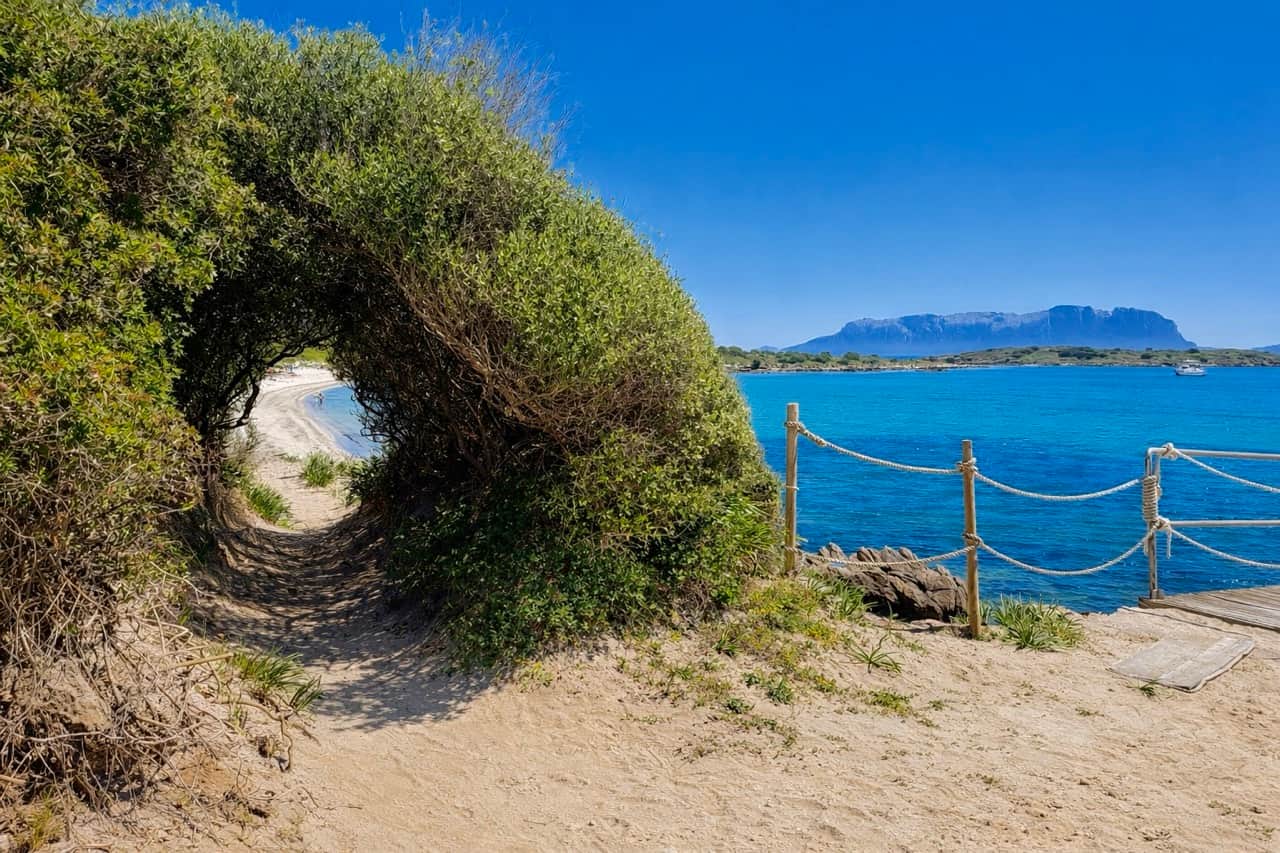
Pittulongu beach near Olbia looking towards Isola Tavolara — Sardinia averages over 300 sunny days per year. Photo RENTAL12.
Sardinia Weather: Month-by-Month Climate, Sea Temperature & Best Time to Visit
Sardinia averages 28°C in July and August and 18°C in spring and autumn. Twelve-month temperature, sea, rainfall and sunshine data sourced from Aeronautica Militare and walked on the ground in Olbia by the RENTAL12 team.

Quick Guide
Sardinia has a true Mediterranean climate: hot dry summers averaging 28–32°C in July and August with sea temperatures of 25–27°C, and mild damp winters averaging 9–10°C with sea around 13–14°C. The island gets 2,500–2,900 sunshine hours a year (Aeronautica Militare normals) and only 500–700 mm of rain, almost all of it between October and March. June and September are the sweet-spot months — 25–28°C air, 22–25°C sea, low rainfall and fewer crowds than peak August.
Live tools for your Sardinia stay
Real-time helpers that update every day with current Sardinia conditions.
1. Sardinia Climate — the Mediterranean headline numbers
Quick answer: Sardinia sits squarely in the hot-summer Mediterranean climate zone (Köppen Csa): average annual temperature 17–18°C, 2,500–2,900 sunshine hours, 500–700 mm of coastal rainfall, and a sharp split between a dry warm half (April–September) and a wet mild half (October–March). Sea temperature swings from about 13°C in February to 27°C in August.
Sardinia is the second-largest island in the Mediterranean (24,090 km²) and its climate varies more by altitude and exposure than by latitude. The coast where 95% of visitors stay — Olbia, Costa Smeralda, Cagliari, Alghero — has classic Mediterranean conditions: hot, dry summers, mild damp winters, very little frost. The inland mountains (Gennargentu peaks at 1,834 m) are noticeably cooler and wetter, and the only place in Sardinia where snow regularly falls.
For travel-planning purposes three numbers matter most: the annual sunshine total (around 2,700 hours, comparable to Sicily and southern Spain), the summer sea-temperature peak in August (~27°C), and the rainfall concentration — roughly 75% of the year's rain falls in just 5 months (October–February). Once you internalise that pattern, the rest of the year-round picture follows.
2. Sardinia Temperature by Month — climate table (air, sea, rain, sun, wind)
Quick answer: Below are the 1991–2020 climate normals for coastal northern Sardinia (Olbia/Costa Smeralda). July and August peak at 30–32°C air and 25–27°C sea; January and February sit at 9–10°C air and 13–14°C sea. Rain peaks in November–December (~80–100 mm each); July gets <5 mm.
| Month | Avg high (°C) | Avg low (°C) | Sea (°C) | Rain (mm) | Rain days | Sun (hrs/day) | Verdict |
|---|---|---|---|---|---|---|---|
| January | 14 | 7 | 14 | 63 | 8 | 5 | Coolest & wettest |
| February | 14 | 7 | 13 | 55 | 7 | 6 | Almond blossom |
| March | 16 | 8 | 14 | 48 | 7 | 7 | Variable, spring starts |
| April | 18 | 10 | 15 | 50 | 7 | 8 | Wildflowers peak |
| May | 22 | 13 | 18 | 25 | 4 | 10 | Beach-ready |
| June | 26 | 17 | 22 | 12 | 2 | 11 | Sweet spot start |
| July | 30 | 20 | 25 | 4 | 1 | 12 | Peak heat & crowds |
| August | 31 | 21 | 27 | 11 | 2 | 11 | Sea warmest |
| September | 27 | 18 | 25 | 40 | 4 | 9 | Sweet spot end |
| October | 22 | 14 | 22 | 68 | 6 | 7 | Warm sea, lower prices |
| November | 18 | 11 | 18 | 85 | 8 | 5 | Wet, fewer tourists |
| December | 15 | 8 | 15 | 75 | 8 | 4 | Cool & very quiet |
Source: Aeronautica Militare — Servizio Meteorologico, 1991–2020 climate normals for Olbia / Costa Smeralda station, supplemented with Copernicus Marine Service sea-surface temperatures and Sardegna Turismo regional summaries. Values rounded to whole degrees.
Two patterns stand out. First, the sea lags the air by ~6–8 weeks: the air peaks in late July, the sea in mid-August. That's why September feels warmer in the water than its air temperature suggests, and why May is sunny but the sea is still cold for swimming. Second, the rainfall curve is not bell-shaped: July is almost rainless (4 mm average), then rainfall ramps up sharply through autumn and stays high through December before fading by March.
3. Summer (June–September) — peak heat & the warmest sea
Quick answer: Summer in Sardinia means 26–32°C air, 22–27°C sea, near-zero rain, and 11–12 hours of sunshine a day. July and August are the hottest and most crowded; June and September match them on weather with 30–50% lower accommodation prices.
Best for:
Beach time, swimming, sailing, summer festivals, long evenings outdoors. Avoid if you need cool nights, cheap prices, or want to drive across the island without traffic.
June is the gentlest of the four: typical highs of 26°C, lows of 17°C, sea around 22°C and the Mistral wind often blowing in the afternoon to cool things down. Rain is essentially gone after the first week. Beaches are not yet packed; aperitivo hour on Corso Umberto in Olbia is busy but not chaotic.
July and August are peak Italian holiday season — the entire country goes on holiday in the first three weeks of August (Ferragosto). Coastal Sardinia averages 30–32°C in the daytime and 21°C overnight; heatwaves of 35–40°C occur 5–10 days a year, usually with the African Scirocco wind from the south. Roads to the Costa Smeralda fill from 10:00, beach car parks fill from 09:30, and many restaurants need reservations. Sea temperature peaks at 27°C in mid-August.
September mirrors June: air highs of 27°C, sea still 25°C through the first three weeks, sunshine 9 hours a day. Rain is starting to come back (~40 mm spread over 4 days for the whole month), but it usually arrives as short bursts. After the second week of September, Italian families have gone back to school and the island's price tier drops by 30–50%.
4. Autumn (September–November) — warm sea, fewer crowds
Quick answer: Sardinian autumn keeps the sea warm well into October (22°C average) while air cools to 22–25°C and prices fall. Rainfall starts climbing in October and peaks in November (~85 mm), but most days are still dry and sunny — rain arrives as short, intense bursts.
Best for:
Travellers who want summer-like sea with fewer crowds, hikers, wine-harvest visitors, photographers chasing the gold light, and digital-nomads working flexible weeks.
October is, on the data, the most under-rated travel month in Sardinia. Sea temperature averages 22°C across the month — warmer than May, late June and most days at British or German seaside resorts in mid-summer. Air highs sit at 22°C, with sunshine 7 hours a day. Rainfall jumps to 68 mm spread over ~6 days — meaning 25 out of 31 October days are typically dry. Wine harvest (Cannonau, Vermentino) is at its peak; vineyards in Gallura around Monti and Berchidda are open for visits.
November is the first month that genuinely feels autumnal: air highs of 18°C, lows of 11°C, sea cooling to 18°C. Rainfall peaks at ~85 mm over 8 days. This is the cheapest mainstream month to visit Sardinia — accommodation can be 50–60% below July rates — and bird-watching is at its best as flamingos congregate in the Olbia, Cagliari and Oristano lagoons.
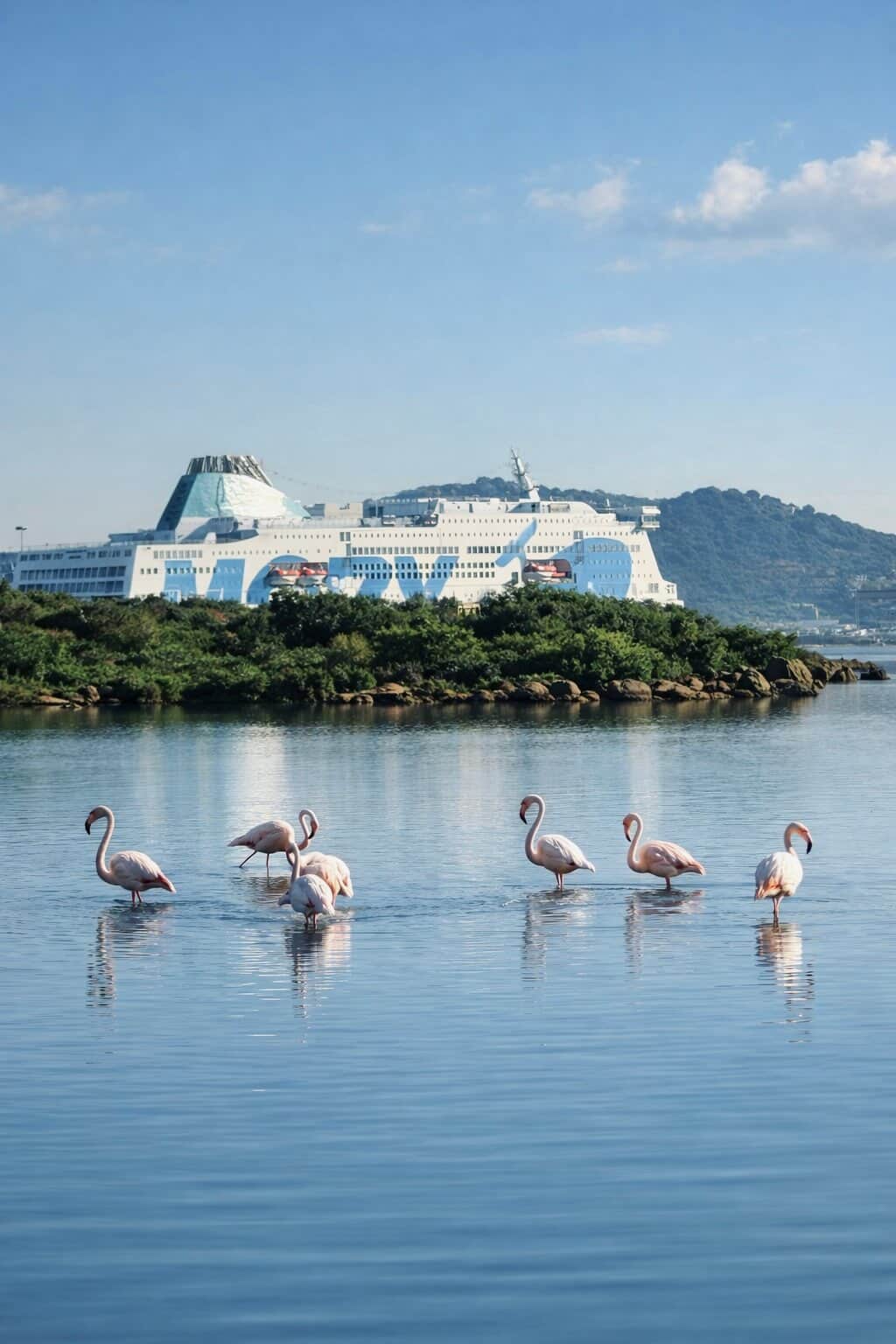
Flamingos in the Olbia lagoon — late autumn through spring is peak flamingo season in the Olbia, Cagliari and Oristano lagoons. Photo RENTAL12.
For the deep October–September dive (including dedicated month-specific data and shoulder-season itineraries), see our companion guide: Sardinia in October & September.
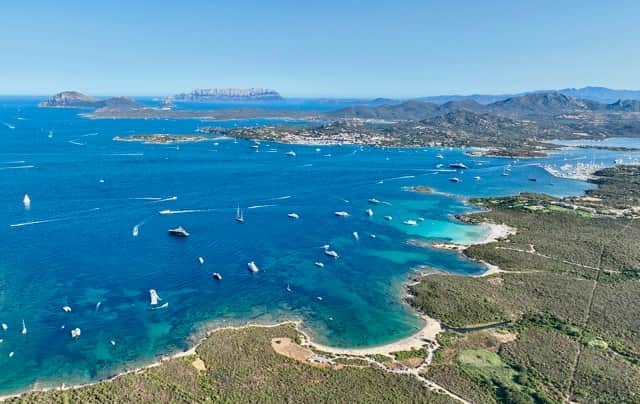
Porto Rotondo bay on Costa Smeralda — classic June–September conditions, calm sea, 25–27°C water. Photo RENTAL12.
5. Winter (December–February) — mild, damp & very quiet
Quick answer: Sardinian winters are mild rather than warm: coastal highs of 14–15°C in December, 14°C in January and February, lows of 7–8°C. Frost is rare at sea level, snow essentially absent. Rainfall is the year's heaviest (60–75 mm per month) but spread over fewer than 10 days each month.
Best for:
Long stays, remote work, hikers willing to dress for variable weather, food/wine travellers seeking authentic local life. Avoid if you need beach/swim weather or short daylight hours bother you (sunset around 17:00 in late December).
December sees the year's first proper cold snaps; daytime is usually 13–16°C and sunny, but bursts of N/NW Mistral wind can drop the feels-like temperature into single digits. Christmas in Sardinia is family-and-village-focused; touristically very quiet outside of Cagliari and Olbia town centres.
January is the coldest month on the calendar but only marginally so — coastal Olbia averages 14°C high, 7°C low, with one or two cold snaps per decade dipping to 2–3°C overnight. Inland and at altitude it's another world: Gennargentu peaks above 1,800 m receive snow several times a year and the small Bruncu Spina ski lift opens for 4–6 weeks a season. At sea level, frost is rare enough that locals talk about it for years afterwards.
February averages match January but feel different — days are visibly longer, almond blossom starts around mid-February, and the first warm sunny days of the year reliably arrive in the last week. The sea is at its coldest of the year (13°C); swimming is feasible only in a wetsuit.
6. Spring (March–May) — wildflowers & warming sea
Quick answer: Spring runs from cool-and-variable in March (16°C air, 14°C sea) to genuinely beach-ready by mid-May (22°C air, 18°C sea, 10 hours of sun). It's the most photogenic season: macchia mediterranea in bloom, low tourist numbers and easy car-rental availability.
Best for:
Hikers and trail-runners, photographers, families on Easter break, archaeology day-trips, anyone wanting genuine Mediterranean spring weather without summer crowds or prices.
March is genuinely variable — one week 20°C and sunny, the next 12°C with two days of rain. Sea temperature is still 14°C, too cold for casual swimming. The advantage: vineyards, archaeological sites and trekking trails are quiet and the light is exceptional.
April is the wildflower month. Cistus (cistus, the white-and-pink "Mediterranean rose"), broom, orchids and asphodels cover the granite hills; the wildflower display in the granite uplands around Arzachena, Olbia and Aggius is one of the best in the western Mediterranean. Weather is settled by mid-April: 18°C average highs, 10°C lows, 8 hours of sun. The sea is still 15°C — cold for swimming but fine for stand-up paddling in a wetsuit.
May tips into beach-ready territory. The second half of May regularly sees 25°C days and the sea climbs to 18–20°C — comfortable for active swimmers. May rainfall is 25 mm spread over 4 days, the lowest since the previous October. This is the start of the "value summer" window: weather like June, prices like March.
7. Sea temperature in Sardinia by month
Quick answer: Sardinia's sea temperature ranges from 13°C in February to 27°C in August, lagging the air by about 6 weeks. Comfortable casual swimming (sea ≥21°C) runs from late May or early June through to the end of October.
Source: Copernicus Marine Service and seatemperature.org regional averages (Olbia / Cagliari / Alghero stations), 2015–2024 means. Rounded to whole degrees.
A few practical notes on swimming temperature thresholds: below 16°C, the average European swimmer feels cold within 2–3 minutes; 16–20°C is wetsuit territory for most people; 20–23°C is the threshold below which casual swimming becomes uncomfortable for many; 24°C and above feels properly warm. Shallow, sandy bays (Pittulongu, Cala Brandinchi, Porto Istana) warm 1–2°C above this average; rocky deep-water spots run cooler.
8. Wind & the Mistral effect
Quick answer: Sardinia is one of the windier Mediterranean islands. The dominant wind is the Mistral (NW), blowing 8–30 km/h on roughly half of all days year-round, with summer afternoons typically calmer. The Scirocco (S/SE) brings heat and dust from Africa for 2–5 days at a time, usually in late spring and summer.
What matters for travellers is that on any given day, around half the Sardinian coastline is sheltered from the prevailing wind. When the Mistral is blowing from the NW, east-coast and south-east-coast beaches (Cala Brandinchi, Porto Istana, Pittulongu, Cala Sassari, Costa Rei) are calm and warm; when the wind backs to S/SE (Scirocco), north-facing beaches (Capo Coda Cavallo, parts of Costa Smeralda) become the lee shore. The Mistral effect explains why three Sardinian beaches can have totally different swim conditions on the same day.
Use our live wind & beaches tool to see which beach is sheltered right now, with the current wind speed and direction matched to the lee shore of the day.
9. Olbia, Cagliari, Alghero — regional differences
Quick answer: Cagliari (south coast) is about 1–2°C warmer than Olbia (north-east) and Alghero (north-west) across the year, and 10–15% drier. Costa Smeralda is essentially identical to Olbia for weather. The Gennargentu mountains in the interior can be 8–12°C cooler at altitude and get snow in winter.
| Location | Jan avg high | Jul avg high | Annual rain | Annual sun |
|---|---|---|---|---|
| Olbia / Costa Smeralda (NE) | 14°C | 30°C | 580 mm | 2,700 hrs |
| Alghero (NW) | 14°C | 29°C | 560 mm | 2,700 hrs |
| Cagliari (S) | 15°C | 31°C | 430 mm | 2,800 hrs |
| Nuoro (interior, 555 m) | 11°C | 28°C | 800 mm | 2,400 hrs |
| Gennargentu (1,800 m) | 4°C | 22°C | 1,100 mm | 2,200 hrs |
The north-east where RENTAL12 operates (Olbia, Golfo Aranci, Costa Smeralda) sits in the wettest of the coastal stations — ~580 mm a year against Cagliari's 430 — but is still drier than London (615 mm), Berlin (570 mm) or any UK / German coastal city. The trade-off is a cooler sea (Costa Smeralda peaks at 27°C in August; the gulf south of Cagliari can reach 28°C) and a marginally cooler winter.
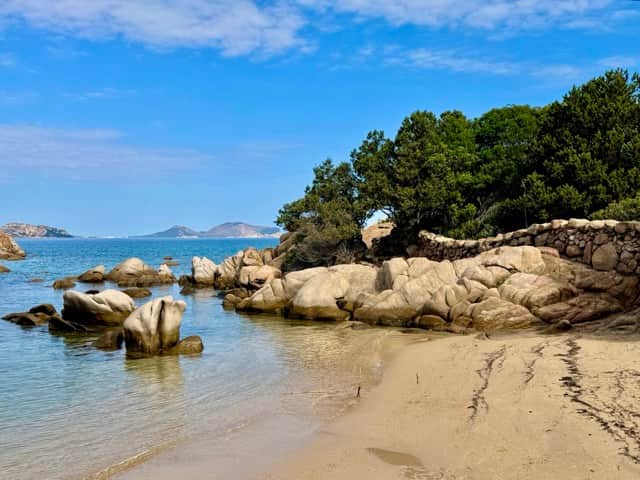
A beach near Olbia in late afternoon — September and early October still feel like high summer in the water. Photo RENTAL12.
10. Best time to visit Sardinia by travel style
Quick answer: Swimmers and sun-seekers should target mid-June to mid-September. Value-seekers want late May to mid-June or the last two weeks of September. Hikers and photographers want April–May or October. Quiet-stay specialists want November to March. Avoid the first three weeks of August unless you're already booked.
Best for swimmers & beach days
Mid-June to mid-September: sea 22–27°C, air 26–32°C, near-zero rain. Peak comfort and warmest sea: mid-July to mid-August. Best value within that window: second half of June and second half of September.
Best value (good weather + lower prices)
Mid-May to mid-June and late September to mid-October: 22–28°C air, 20–25°C sea, 30–50% lower accommodation than peak August. See our best time to visit Sardinia guide for full pricing tiers.
Best for hikers & outdoor adventure
April–May for wildflowers and 18–22°C trekking weather, October for warm-but-not-hot conditions on Gennargentu trails (Selvaggio Blu, Tiscali). Avoid July–August on long inland walks — sustained 30°C+ heat is dangerous.
Best for "summer feel without summer crowds"
Mid-September to early October: 25°C+ sea, 25°C+ air, no Italian school-holiday volume, beaches half-empty, restaurants relaxed. The single most cost-effective sweet spot.
Long-stay / digital-nomad / remote-work
Late October to early May: mild weather, lowest prices of the year (50–65% below peak), full local life with cafes, restaurants and gyms operating on locals' timetables. Days are short November–February (sunset ~17:00) but daylight stretches fast from March.
Avoid if…
You dislike crowds & high prices — skip the first three weeks of August. You need warm sea — avoid December–April. You can't tolerate sustained 30°C+ heat — skip July–August. You need long daylight hours — avoid November–January (sunset 17:00–17:30).
11. What to pack by season
Quick answer: Summer needs light cotton, swimwear, hat, SPF 50; winter needs a light jacket, jumper and a rain shell. Spring and autumn are about layers and a light waterproof. Closed shoes are useful year-round if you'll do any archaeology or trail walking.
Spring (Mar–May)
- Lightweight T-shirts + 1 long-sleeve
- Light fleece or cardigan for evenings
- Light rain shell
- Walking shoes + sandals
- Hat & SPF 30–50
- Swimsuit (May only)
Summer (Jun–Sep)
- Breathable cotton + linen
- 2–3 swimsuits
- Wide-brimmed hat, sunglasses
- SPF 50+, reef-safe if snorkelling
- Flip-flops + 1 closed pair for evenings
- Light shawl for AC
Autumn (Sep–Nov)
- Layers: T-shirt + light jumper
- Rain shell (especially Oct/Nov)
- Walking shoes
- Swimsuit (Sept & early Oct)
- SPF 30, sunglasses
- Light scarf for evenings
Winter (Dec–Feb)
- Warm jumpers, light jacket
- Rain shell + small umbrella
- Closed shoes (waterproof useful)
- Long trousers / jeans
- Scarf, light hat for evenings
- Sunglasses (low winter sun)
12. Sources & methodology
Quick answer: Temperature, rainfall and sunshine values are 1991–2020 climate normals from Aeronautica Militare — the Italian national weather service — for the Olbia, Cagliari and Alghero stations. Sea temperatures use Copernicus Marine Service averages. Regional summaries cross-check Sardegna Turismo. RENTAL12 walks and verifies seasonal observations on the ground in Olbia.
For climate normals (the 30-year averages that smooth out year-to-year variability) we rely on Aeronautica Militare — Servizio Meteorologico (meteoam.it), which is the official Italian institution publishing WMO-standard data. Sea-surface temperature relies on Copernicus Marine Service satellite re-analysis (1993–present), cross-checked against seatemperature.org for traveller-friendly monthly averages. Regional summaries and altitude-specific data are cross-checked against Sardegna Turismo (sardegnaturismo.it), the official regional tourism authority.
Where the same value differs between sources by more than 1°C or 10 mm we default to the Aeronautica Militare value (most rigorous methodology) and note the divergence. All values on this page are rounded to whole degrees Celsius and to the nearest 5 mm of rainfall to avoid false precision — year-to-year variability is larger than that rounding.
13. Frequently asked questions
Ready to time your Sardinia trip to the perfect weather?
RENTAL12 owns and operates 37 properties in Olbia and Golfo Aranci. All come with air conditioning for summer, central heating for winter, and a local team to point you to the right beach for today's wind direction. Owner-operated since 2021 — rated 4.9★ from 2,000+ 5 star reviews.