🦩 Flamingos in Sardinia — Where to See the Pink Birds Near Olbia
One of the Mediterranean's most surprising wildlife encounters is waiting just minutes from your holiday apartment — wild pink flamingos wading through coastal lagoons at sunrise.
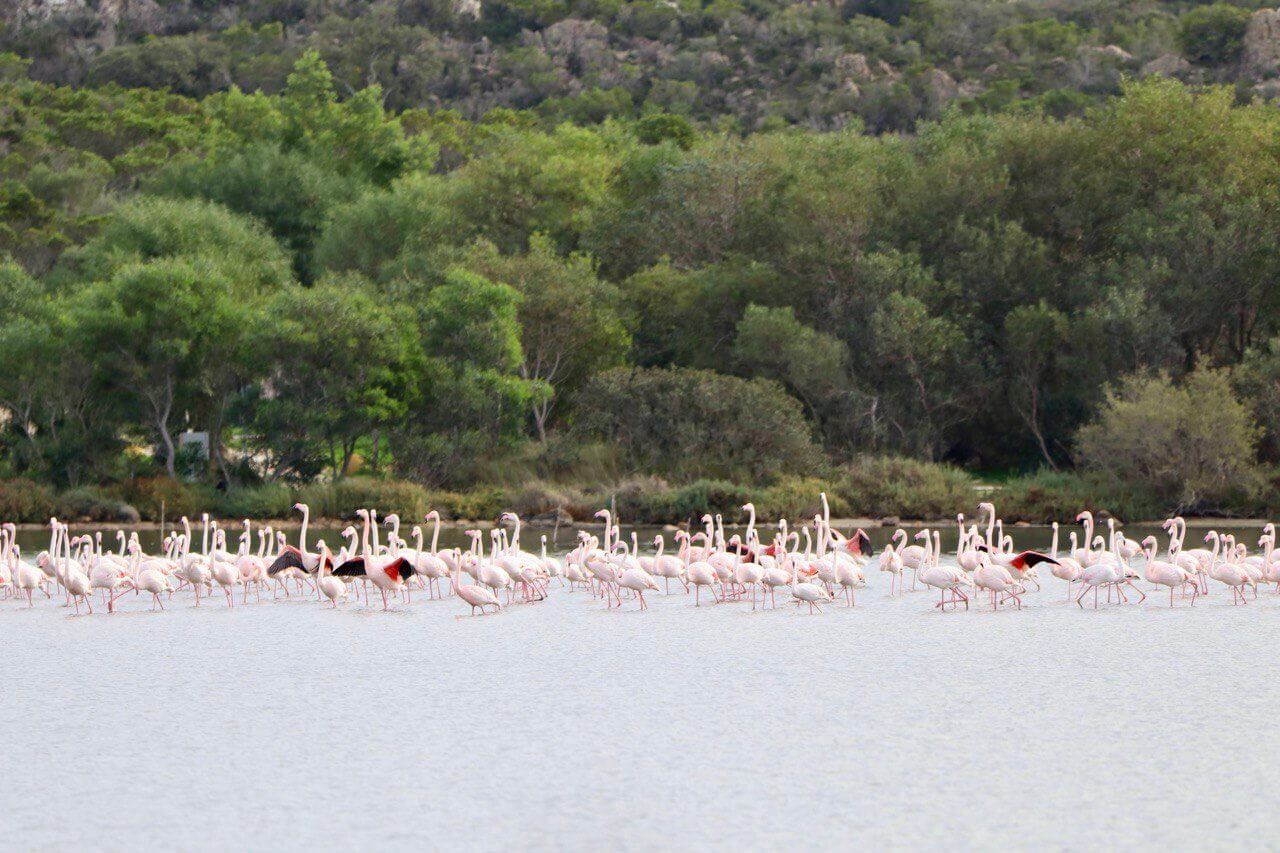
Sardinia is famous for turquoise water, white granite beaches, and wild Mediterranean landscapes. But one of the island's most surprising natural wonders is something many visitors don't expect: wild pink flamingos.
Every year, thousands of Greater Flamingos (Phoenicopterus roseus) gather in Sardinia's coastal wetlands — especially the lagoons and salt marshes near Olbia and San Teodoro. For many visitors landing at Olbia Costa Smeralda Airport, flamingos are actually the first wildlife they see on the island.
In This Guide
Why Flamingos Live in Sardinia
Sardinia offers some of the most pristine lagoon ecosystems in the Mediterranean. The island's coastal wetlands provide exactly what flamingos require: shallow brackish water, protected feeding zones, abundant micro-organisms and brine shrimp, and minimal human disturbance.
Brackish Lagoons
Salt and freshwater mixing creates rich feeding grounds with high concentrations of Artemia salina (brine shrimp) — the flamingo's primary food source.
Natura 2000 Protection
Sardinia's wetlands are part of the EU Natura 2000 network and protected under the Ramsar Convention — ensuring long-term habitat preservation.
Low Pollution
Sardinia has some of the cleanest coastal water in Europe. With minimal industrial activity, the environment supports sensitive species like flamingos year-round.
Because of these conditions, Sardinia now hosts one of the three most important Greater Flamingo breeding colonies in the Western Mediterranean — alongside the Camargue in France and Fuente de Piedra in Spain. The Molentargius colony near Cagliari has been established since 1993 and counts over 20,000 breeding pairs.
🦩 Where to See Flamingos Near Olbia
If you're staying in northeastern Sardinia, you don't need to travel far. Several exceptional flamingo-watching locations are within 30 minutes of Olbia.
San Teodoro Lagoon (Stagno di San Teodoro)
The premier flamingo-watching site in northeast Sardinia. This large, shallow lagoon sits behind the famous La Cinta Beach and regularly hosts hundreds of flamingos. Designated walking paths wind along the lagoon edge with wooden fences and viewing platforms. Flat-bottomed boat tours depart multiple times daily (08:30, 09:30, 18:00, 19:00 — approx. €15, 45 min). Located 25 minutes south of Olbia. Part of the Tavolara Punta Coda Cavallo Marine Protected Area.
→ Access via La Cinta Beach parking or SS125 near Lu Fraili
Poltu Quadu Wetlands (Olbia)
One of the easiest places to spot flamingos — located very close to Olbia Costa Smeralda Airport. Small flocks are often visible from nearby roads and paths. One of those rare places where wildlife appears right next to a city. Perfect for visitors with limited time or families with small children.
→ Just minutes from the airport and Olbia city centre
Tavolara Marine Protected Area
Established in 1997, this 15,000-hectare marine park spans the coasts of Olbia, Loiri Porto San Paolo, and San Teodoro. It contains several wetlands and salt marshes where flamingos occasionally gather. Home to 152 documented bird species — about 80% of all species recorded in Sardinia. One of the most pristine coastal ecosystems in the Mediterranean.
→ Official park site: amptavolara.com
All RENTAL12 properties are within 25 min of San Teodoro Lagoon
📅 Best Time & Season
Flamingos can be seen in Sardinia throughout much of the year, but the timing and quality of sightings varies significantly by month.
| Period | Months | Flamingo Activity | Rating |
|---|---|---|---|
| Winter | Nov – Feb | Smaller groups, some overwintering birds | Fair |
| Early spring | Mar – Apr | Return migration, flocks building | Good |
| Peak season | May – Jul | Nesting, courting, chick-rearing — largest flocks | Peak |
| Late summer | Aug – Sep | Feeding, juveniles fledging | Good |
| Autumn | Oct | Migration begins, declining numbers | Fair |
Best Time of Day: Sunrise
Early morning is the most peaceful and flamingos are most active. Fewer visitors, softer light, and often the most magical reflections on the lagoon.
Runner-up: Sunset
Golden hour creates stunning pink-on-pink reflections. San Teodoro Lagoon's evening boat tours (18:00 & 19:00) are timed specifically for this.
🧪 Why Flamingos Are Pink
Flamingos are not born pink. Young birds are grey or pale white. Their iconic colour develops gradually through their diet.
They feed on organisms rich in carotenoid pigments — primarily brine shrimp (Artemia salina), algae, and plankton. These pigments accumulate in their feathers and skin over time, producing the characteristic pink-to-deep-rose colour spectrum.
In Sardinia, the lagoons are rich with exactly the right organisms. This is why Sardinian flamingos tend to display particularly vibrant colouring — a visible testament to the island's clean, nutrient-balanced ecosystem.
🦩 Want to wake up to flamingo sunrises?
Quick Facts & Numbers
Species Profile
Greater Flamingo (Phoenicopterus roseus)
Height: 110–150 cm · Wingspan: up to 165 cm
Lifespan: 20–30 years in the wild
Diet: brine shrimp, algae, plankton
Status: Least Concern (IUCN)
Sardinia's Role
Together with the Camargue (France) and Fuente de Piedra (Spain), Sardinia's Molentargius colony hosts over 85% of the Western Mediterranean's breeding flamingos. Sardinia is the youngest of the three — established only since 1993, it is the fastest growing.
🌿 Flamingos & Sardinia's Clean Environment
Flamingos are considered bio-indicator species. Their presence reliably signals a healthy ecosystem — they require clean water, stable wetlands, and abundant natural food sources. If flamingos thrive somewhere, the environment around them is genuinely well preserved.
This matters for visitors too. The same environmental quality that attracts flamingos also means cleaner beaches, purer water, and healthier marine ecosystems for swimming, snorkelling, and exploring. When you see flamingos in Sardinia, you're seeing living proof that the island's commitment to environmental protection is real.
🛡 How to Watch Flamingos Respectfully
Flamingos are wild, protected animals. Observing a few simple guidelines helps keep Sardinia's wetlands healthy for future generations.
- Stay on designated paths and boardwalks
- Observe from a distance — use binoculars or a zoom lens
- Visit at sunrise or sunset for the best experience
- Take the San Teodoro boat tour for a guided, low-impact viewing
- Bring a camera with at least 200mm zoom for quality photos
- Never approach, chase, or attempt to touch flamingos
- Never feed wild flamingos — it disrupts their natural diet
- Avoid loud noises, music, or sudden movements near the lagoon
- Do not fly drones over flamingo habitats without permits
- Never leave litter — take everything back with you
Family, Luxury, Parking, Old Town, Off-Season & more
Stay Close to Sardinia's Flamingo Lagoons 🦩
The best flamingo habitats are located just 5–25 minutes from RENTAL12's properties in Olbia's historic centre. Wake up early, drive to San Teodoro Lagoon, watch the sunrise with the flamingos, and be back for a cappuccino on the terrace before most people are awake.
Explore Sardinia's Wildlife From Your Base in Olbia
Owner-operated apartments · Direct booking · Personal service · 2,000+ 5 star reviews
🦩 Frequently Asked Questions
Are flamingos native to Sardinia?
Are Greater Flamingos native to Sardinia or did they migrate there recently?
Greater Flamingos (Phoenicopterus roseus) are migratory birds that have established stable year-round breeding colonies in Sardinia since 1993, particularly at Molentargius near Cagliari and in coastal lagoons near Olbia and San Teodoro.
Flamingos are primarily migratory, but Sardinia's colonies have become so well-established that many birds now remain on the island year-round. The Molentargius colony near Cagliari was the first Italian breeding site, founded in 1993, and has grown into one of the three most important in the Western Mediterranean.
Can you see flamingos near Olbia airport?
Can visitors see flamingos near Olbia Costa Smeralda Airport in Sardinia?
Yes — the Poltu Quadu wetlands near Olbia airport frequently host small flamingo groups visible from nearby roads, making flamingos one of the first wildlife sights for many arriving visitors.
The Poltu Quadu wetlands sit very close to the airport perimeter. Many visitors are surprised to spot flamingos within minutes of landing. For the best sightings, head to San Teodoro Lagoon — only 25 minutes south — where larger flocks gather reliably.
What is the best month for flamingos?
What is the best month to see flamingos in Sardinia for birdwatching and photography?
May to July is peak season for flamingo watching in Sardinia, coinciding with nesting, feeding, and chick-rearing activity in the coastal lagoons.
While flamingos can be spotted from March through October, the period from May to July offers the largest concentrations, the most active behaviour (courtship displays, nesting, and chick-rearing), and the best light conditions for photography. Early June is considered the absolute peak.
Are flamingos protected in Sardinia?
Are flamingos in Sardinia legally protected and what conservation frameworks apply?
Yes — Sardinia's flamingo habitats are protected under the EU Natura 2000 network, the Ramsar Convention on Wetlands, and local conservation regulations including the Tavolara Punta Coda Cavallo Marine Protected Area.
Multiple layers of protection exist. The EU Birds Directive (2009/147/EC) and Habitats Directive (92/43/EEC) cover flamingo habitats under the Natura 2000 network. Locally, the Tavolara Marine Protected Area (est. 1997, 15,000 hectares) encompasses the San Teodoro and Olbia coastal zones. Disturbing wildlife in these zones can result in fines under Italian environmental law.
Why are flamingos pink?
Why are flamingos pink and what determines the intensity of their colour?
Flamingos are born grey-white and turn pink from carotenoid pigments in their diet of brine shrimp, algae, and plankton — brighter pink indicates a healthier, better-fed bird, which also influences mating success.
The carotenoid pigments (similar to those in carrots and tomatoes) are metabolised and deposited in growing feathers and skin. In Sardinia, the rich lagoon ecosystems produce especially vibrant flamingos. Colour intensity also plays a role in mate selection — brighter birds are generally preferred, as colour signals overall fitness.
Where exactly is the best viewing spot?
Where is the best place to see flamingos near Olbia in northeast Sardinia?
San Teodoro Lagoon (Stagno di San Teodoro), about 25 minutes south of Olbia, is the best and most accessible flamingo-watching location in northeast Sardinia, with designated paths, boat tours, and hundreds of birds behind La Cinta Beach.
Access the lagoon via the La Cinta Beach car parks or from the SS125 near Lu Fraili (signposted as "Peschiera"). The paths are flat and easy, suitable for families and all fitness levels. For the closest views without disturbing the birds, take the guided boat tour — 45 minutes on a flat-bottomed boat through the heart of the lagoon.
How many flamingos live in Sardinia?
How many Greater Flamingos live in Sardinia and how significant is the population?
Sardinia seasonally hosts up to 20,000+ Greater Flamingos, with Molentargius near Cagliari being the largest colony and one of the three most important breeding sites in the Western Mediterranean alongside the Camargue and Fuente de Piedra.
The Molentargius-Saline Regional Park near Cagliari is the epicentre, but significant numbers also inhabit lagoons across the island, including northeast Sardinia. The colony has shown consistent growth since 1993, with breeding success rates averaging around 70%. Together with the Camargue and Fuente de Piedra, these three sites account for over 85% of all Western Mediterranean breeding pairs.
Can I take a boat tour to see flamingos?
Can visitors take a boat tour to see flamingos at San Teodoro Lagoon in Sardinia?
Yes — flat-bottomed boat tours depart from the north end of San Teodoro Lagoon multiple times daily (typically 08:30, 09:30, 18:00, 19:00), last about 45 minutes, and cost approximately €15 per person.
The tours are run by local operators and use low-impact flat-bottomed boats that don't disturb the shallow lagoon bed or the birds. The evening tours (18:00, 19:00) are especially popular as they coincide with sunset and the golden-hour light. No advance booking is typically needed outside of August, but arriving 15 minutes early is recommended.
🦩 Ready to Discover Sardinia's Wildlife?
Your flamingo adventure starts from an apartment in Olbia's historic centre — direct booking, no middleman, 2,000+ 5 star reviews
Explore More Guides
Best Beaches Near Olbia
From La Cinta to hidden coves — the definitive beach guide for the northeast coast.
Day Trips from Olbia
La Maddalena, Tavolara Island, Costa Smeralda, and more — all within easy reach.
Sustainable Travel Sardinia
How to explore the island responsibly — eco-tips, low-impact transport, and green stays.
Sardinia for Families
Kid-friendly beaches, restaurants, activities, and family apartment picks.
Rent a Boat — Olbia
Skippered or self-drive — explore the coast, islands, and hidden beaches by sea.
Do I Need a Car?
Getting to San Teodoro and other flamingo spots — transport options explained.