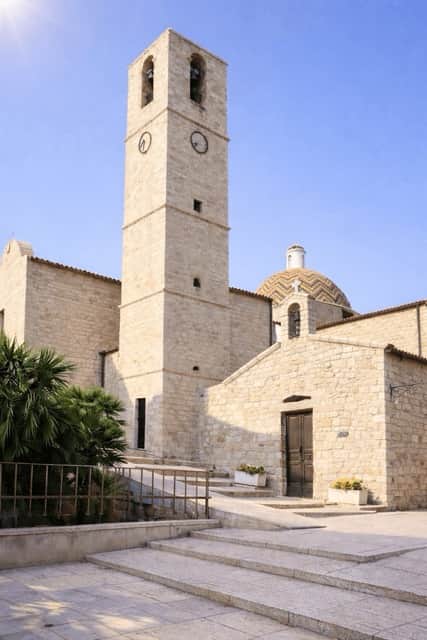
Basilica di San Simplicio, Olbia — the Christian-era heritage layer that sits above the much older Bronze Age sites covered in this guide. Photo RENTAL12.
Archaeological Sites in Northern Sardinia: Nuraghi, Giants' Tombs & Sacred Wells near Olbia
Eight Bronze Age sites within 45 minutes of Olbia and Golfo Aranci — tickets, opening hours, walking distances, and a one-day itinerary. Verified on the ground by the RENTAL12 team, May 2026.

Quick Guide
Northern Sardinia, within a 45-minute drive of Olbia and Golfo Aranci, holds eight major Bronze Age sites: the late nuragic complex of Nuraghe La Prisgiona (Arzachena, ~14th–9th century BC), Nuraghe Albucciu and the cultic Tempietto Malchittu, two of Sardinia's tallest giants' tombs at Coddu Vecchju and Li Lolghi, the late-Bronze-Age Pozzo Sacro Sa Testa at the edge of Olbia, the Olbia Archaeological Museum with its Roman shipwreck hall (free entry), and the Tomba dei Giganti di Su Mont'e s'Abe in Olbia's hinterland. Plan one to two days, base in any RENTAL12 apartment in Olbia or villa with pool in Golfo Aranci.
1. What is a nuraghe — and why North Sardinia matters
Quick answer: A nuraghe is a Bronze Age dry-stone tower built in Sardinia between roughly 1900 BC and 730 BC and found nowhere else on Earth. Around 7,000 still stand. North Sardinia holds some of the latest and best-preserved examples — the Arzachena cluster alone has a full nuragic village, two of the tallest giants' tombs, and a sacred-well shrine 4 km from Olbia.
Nuraghi (singular: nuraghe) are circular towers made of large basalt or granite blocks fitted without mortar, often topped by smaller upper chambers and surrounded by a village of stone huts. The Italian Ministry of Culture counts about 7,000 still standing across Sardinia, of which the late-Bronze-Age complex of Su Nuraxi of Barumini in south-central Sardinia is the UNESCO benchmark — but it sits 3.5 hours south of Olbia, so for a guest staying in northern Sardinia it is a separate trip, not a day excursion.
The far north (the historical Gallura region and the territory around Olbia) is less famous than Barumini but holds three things you cannot easily see further south: the largest and best-conserved Gallura-type giants' tombs at Coddu Vecchju and Li Lolghi, the late nuragic village complex of La Prisgiona, and a working sacred-well shrine at Sa Testa on the outskirts of Olbia itself. Most are within 40 minutes of any RENTAL12 apartment or villa, which is why we built this guide as a north-tilted complement to the general Sardinia archaeology articles you will find elsewhere.
2. Nuraghe La Prisgiona — Arzachena
Quick answer: Nuraghe La Prisgiona is a late-Bronze-Age nuragic complex 7 km outside Arzachena, with a central tower, three lateral towers, a deep interior well still containing water, and the excavated remains of around 100 huts. Excavations have been ongoing since 1995. About 40 minutes from Olbia city centre by car.
Period: Late Bronze Age, around 14th–9th century BC
Drive from Olbia centre: ~40 minutes (35 km)
Drive from Golfo Aranci: ~30 minutes
Ticket (verify): ~€6 single-site, or ~€10 combined Arzachena Archaeological Park pass (covers Coddu Vecchju + Li Lolghi)
Operator: Geseco Arzachena · gesecoarzachena.it
Coordinates: 41°02′37″N · 9°23′10″E
La Prisgiona ("the prison" in Gallura dialect, named for the dense stone walls) sits in the Capichera valley just south of Arzachena, 7 km from the town and about 40 minutes from any of our Olbia apartments. The complex centres on a quadrilobed nuraghe — a central tower with three lateral towers fitted around it — and an internal courtyard with a corbelled well around 7 metres deep that has been continuously full of water since excavation began in 1995.
Around the central nuraghe, archaeologists have so far identified the remains of roughly 100 huts, including a "chief's hut" with stone benches around the perimeter and a circular hearth. Finds include grindstones, decorated pottery and a small bronze statue, displayed at the Olbia Archaeological Museum (see section 8).
It is one of the easiest nuragic complexes to read for a first-time visitor — paths are well-laid, signage is bilingual Italian/English, and the central tower can be entered. Allow about 75 minutes on site plus drive time.
3. Nuraghe Albucciu — Arzachena
Quick answer: Nuraghe Albucciu is a rare "platform" nuraghe — rectangular rather than the usual circular plan — built into a granite outcrop just outside Arzachena. It dates to the Middle-to-Late Bronze Age and sits about 35 minutes from Olbia. The combined ticket includes the Tempietto Malchittu, a 30-minute walk away.
Period: Middle Bronze Age to Late Bronze Age
Drive from Olbia: ~35 minutes (30 km)
Ticket (verify): Combined Arzachena Archaeological Park pass typically ~€10
Operator: Geseco Arzachena
Albucciu is interesting because it breaks the usual nuraghe rule. Instead of the classic conical tower, it is rectangular and was built into a natural granite shelter — a "corridor" or "platform" nuraghe in the archaeological literature, one of the older typologies, predating the classic tholos nuraghi. From the upper level there is a wide view across the Arzachena valley which by itself makes the short visit worthwhile.
Pair it with the Tempietto Malchittu (next section): same ticket, the walking trail between the two sites takes about 25 minutes through the typical Gallura granite-boulder landscape with cork oaks and lentisk.
4. Tempietto Malchittu — Arzachena
Quick answer: The Tempietto Malchittu is a Middle Bronze Age cultic building — one of the very few "megaron-type" temples in Sardinia, with a rectangular cella and a forecourt. It sits a 25-minute walk from Nuraghe Albucciu and is included in the same Arzachena Archaeological Park ticket.
Malchittu is the kind of site that rewards a deliberate visit. The footprint is small — a single rectangular chamber with a stone bench running along the inside wall, an apsidal end, and traces of a sacrificial hearth — but it is the only nuragic-era temple of its specific layout standing in Gallura, and the walk to reach it through the granite tafoni weathering forms is itself worth the half hour. Wear closed shoes and bring water in summer.
5. Tomba dei Giganti di Coddu Vecchju — Arzachena
Quick answer: Tomba dei Giganti di Coddu Vecchju ("Coddu Ecchju" in the local Gallura form) is a Bronze Age collective tomb famous for its 4-metre-tall central stele forming a curved exedra at the entrance. It is the tallest standing stele of its type in Sardinia, dated to around 2400–1600 BC, and 4 km from Arzachena.
Period: Bronze Age (Bonnànaro and Gallura phases, ~2400–1600 BC)
Drive from Olbia: ~40 minutes
Drive from Golfo Aranci: ~30 minutes
Stele height: ~4 m — tallest in north Sardinia
Operator: Geseco Arzachena (combined ticket)
A giants' tomb (tomba dei giganti) is a collective Bronze Age burial: a long stone-lined corridor up to 10 metres long where the dead were laid, fronted by a curved exedra — a semicircular wall of vertical slabs — with one tall central stele in the middle. The opening at the foot of the stele is small enough to be symbolic rather than functional.
Coddu Vecchju is the showpiece of the Gallura type. The central stele stands roughly 4 metres tall, carved with a horizontal moulding and a smaller "false door" at its base, and the exedra wall extends about 13 metres across. The corridor behind it, partially collapsed but still readable, was used over multiple generations.
The site is fenced and on a marked path from a small parking area. Allow 30 minutes for the visit; combine with Li Lolghi (10 minutes away) and Nuraghe La Prisgiona for a single half-day loop.
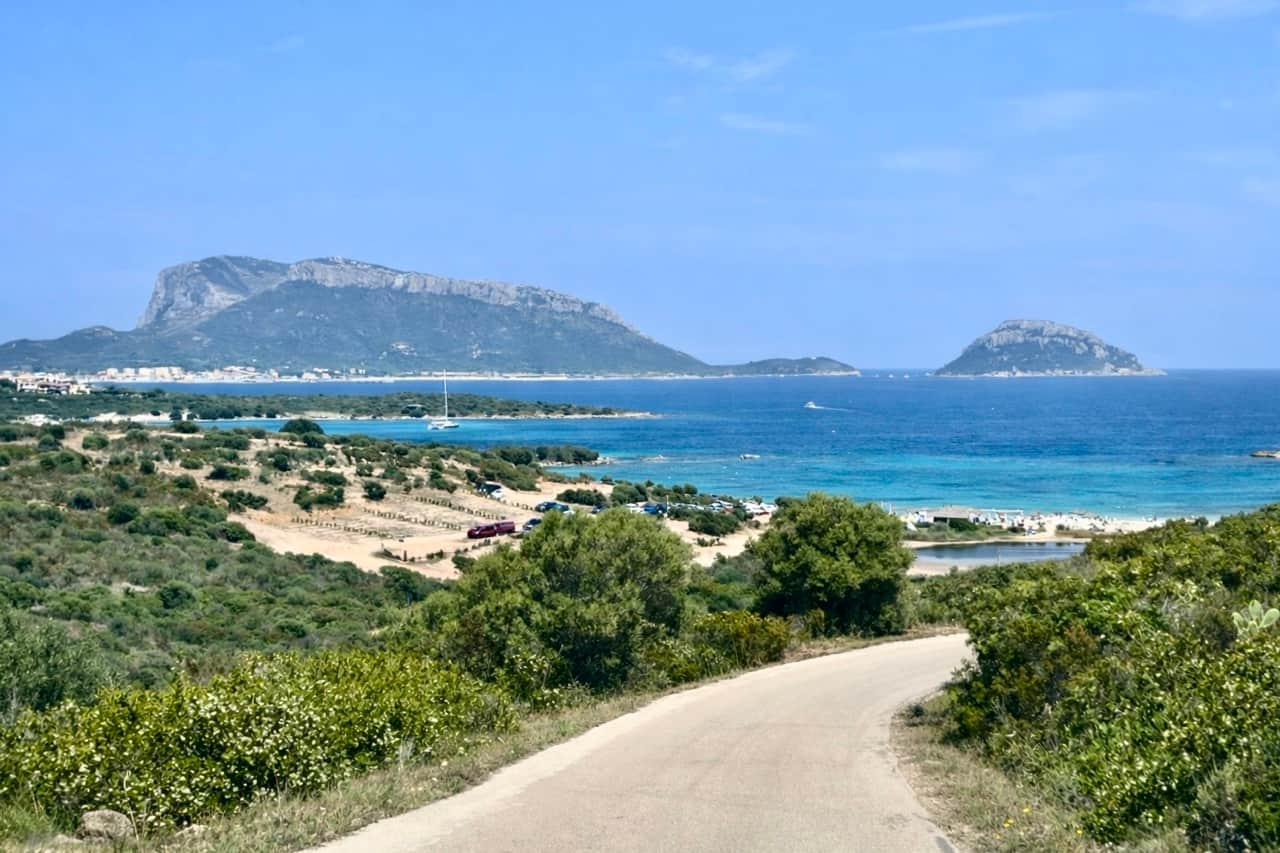
Cala Sassari, a few kilometres from the Arzachena archaeological cluster. Pair beach mornings with afternoon site visits. Photo RENTAL12.
6. Tomba dei Giganti di Li Lolghi — Arzachena
Quick answer: Tomba dei Giganti di Li Lolghi is a second Gallura-type giants' tomb in the Arzachena cluster, slightly older and longer than Coddu Vecchju, with a 3-metre central stele and a 27-metre burial corridor. It is 10 minutes from Coddu Vecchju on the same combined ticket.
Li Lolghi pairs naturally with Coddu Vecchju and is sometimes overlooked because it is less photogenic — the stele is shorter and the exedra slightly more weathered — but archaeologically it is the more revealing of the two: the long corridor was built over the older base of a smaller Bonnànaro-period allée couverte, giving a clean stratigraphy of how a Bronze Age tomb was extended and re-extended over generations. The site is a 10-minute drive from Coddu Vecchju and on the same combined ticket.
7. Pozzo Sacro Sa Testa — Olbia
Quick answer: Pozzo Sacro Sa Testa is a late-Bronze-Age sacred well (water-cult shrine) on the eastern edge of Olbia, with an intact corbelled chamber, a 17-step staircase descending to the water, and a circular forecourt with stone benches. About 4 km from RENTAL12 historical-centre apartments.
Period: Late Bronze Age (~13th–9th century BC)
Distance from Olbia centre: 4 km (5 min drive, 50 min walk, 15 min bus)
Entry: Currently free outdoors (verify if ticket-managed)
Type: Pozzo sacro — nuragic water-cult sanctuary
Sacred wells (pozzi sacri) are one of the most striking features of late nuragic religion. They are not domestic — they are temples built around a spring or an artesian source, with a descending stone staircase, a corbelled chamber over the water, and a forecourt where bronze offerings have been recovered. There are around 40 known on the island. Sa Testa is the one closest to a major town and the easiest to reach without a car.
The Sa Testa site sits on the eastern edge of Olbia, on a small rise near the modern Lo Schenardi neighbourhood, about 4 km from the historical centre. The 17-step staircase descends roughly 7 metres into a perfectly corbelled tholos chamber where the water table is still active. The circular forecourt outside has stone benches and the holes for a wooden roof — bronze figurines and votive offerings have been found in this area, today displayed at the Olbia Archaeological Museum.
This is the site that should be on every Olbia visitor's itinerary, however casual. It is open-air, you can walk down into the chamber, and the proximity to RENTAL12's historical-centre apartments (Via Garibaldi, Via Cavour, Via delle Terme) makes it a practical 90-minute side trip rather than a full excursion.
8. Olbia Archaeological Museum — free entry
Quick answer: The Olbia Archaeological Museum opened in 2002 on a small islet in the harbour, with free entry for everyone. Its centrepiece is a hall of Roman and late-Roman shipwrecks recovered from the harbour mud, alongside nuragic bronze figurines and Phoenician trade goods. A 12-minute walk from the RENTAL12 historical-centre apartments.
Entry: Free for everyone, verified May 2026
Address: Isola Peddone, 07026 Olbia
From RENTAL12 Garibaldi or Cavour: 12-minute walk across the harbour bridge
Typical hours: Tue–Sun, 10:00–13:00 and 16:00–19:00 (verify seasonal)
The museum was built specifically to house the discoveries made during the dredging and modernisation of Olbia's harbour in the late 1990s. Twenty-four ancient shipwrecks were recovered from the harbour silt — most Roman trade vessels, but also late Roman and Byzantine ships, several of which had been deliberately scuttled to block the port against the Vandal raids of 450 AD. Two of them are partly reconstructed inside the museum.
Alongside the shipwreck hall, the permanent collection has nuragic bronze figurines from the Sa Testa sacred well and from Nuraghe La Prisgiona, Phoenician and Punic trade amphorae, Roman everyday objects (oil lamps, glass, coins), and a small medieval section. It is the single best free thing to do indoors in Olbia, and the air-conditioning is welcome on a 35°C summer afternoon.
9. Tomba dei Giganti di Su Mont'e s'Abe — Olbia
Quick answer: Tomba dei Giganti di Su Mont'e s'Abe sits about 20 minutes inland from Olbia, with the longest burial corridor of any giants' tomb in north Sardinia at 28 metres. It is less polished as a visitor site than the Arzachena tombs and remains open-air with no managed entry.
Su Mont'e s'Abe (sometimes "Su Monte e S'Abe") is the giants' tomb on Olbia's own doorstep — about 20 minutes inland from the city, in a quiet rural area. Its burial corridor is the longest in the region at 28 metres, built in opus isodomum of large worked granite blocks. The exedra is partially collapsed, but the stele base still stands and the whole monument is visible from the path. It is open-air, free, and signposted but not staffed — bring water and closed shoes.
10. One-day itinerary from Olbia or Golfo Aranci
Quick answer: A focused one-day archaeology loop from any RENTAL12 apartment covers four sites — Pozzo Sacro Sa Testa and the Olbia Archaeological Museum in the morning, then Nuraghe La Prisgiona and Tomba dei Giganti di Coddu Vecchju near Arzachena in the afternoon — about 90 minutes of total driving and 4 hours of site time.
Suggested day (April–October)
- 09:00 — Walk or 5-minute drive from RENTAL12 apartment to Pozzo Sacro Sa Testa (45 min on site)
- 10:15 — Drive 10 min to Olbia Archaeological Museum, harbour islet — free (75 min)
- 12:00 — Lunch in the old town. Try Trattoria Gianni Pedrinelli or Officina del Gusto for a Sardinian seafood antipasto.
- 14:00 — Drive 40 min north to Nuraghe La Prisgiona, Arzachena (75 min on site)
- 15:45 — Drive 10 min to Tomba dei Giganti di Coddu Vecchju (30 min on site)
- 16:30 — Optional: 10 min to Tomba dei Giganti di Li Lolghi on the same combined ticket (25 min)
- 18:00 — Drive 35 min back to Olbia, or 25 min to Golfo Aranci for sunset at Cala Moresca.
If you prefer a slower pace, split this across two days and add Nuraghe Albucciu and Tempietto Malchittu (same combined ticket — pair them on a half day with the Capichera wine route nearby).
11. Tickets, opening hours, parking, what to wear
Quick answer: The Arzachena Archaeological Park (Geseco) operates a combined ~€10 ticket covering La Prisgiona, Coddu Vecchju, Li Lolghi, Albucciu and Malchittu. Single-site tickets are around €6. Hours are typically 10:00–17:00 in winter and 9:00–19:00 in summer. The Olbia museum is free.
Always check current ticket prices and opening hours on gesecoarzachena.it for the Arzachena sites and at the RENTAL12 reception desk on arrival — we update guest binders monthly. Parking is free at all five Arzachena sites and at Sa Testa; the Olbia museum has a small free lot 100 m from the entrance and is also reachable on foot from the old town across the harbour walkway.
Wear closed walking shoes, especially for Tempietto Malchittu and Su Mont'e s'Abe (uneven granite paths). In July and August carry at least one litre of water per person and avoid the 12:00–16:00 window if you can — most of these sites have little shade.
12. Where to stay — RENTAL12 apartments and villas
Quick answer: RENTAL12 operates 34 owner-operated apartments and villas in Olbia and Golfo Aranci, all within 40 minutes of every site in this guide. Our historical-centre apartments are closest to the Olbia museum and Sa Testa; our AZULIS villas in Golfo Aranci (Athos and Aramis, both with private pool) are closest to the Arzachena cluster.
AZULIS Athos — Golfo Aranci
2BR villa with private pool · 25 min from Coddu Vecchju · sea view of Tavolara
AZULIS Aramis — Golfo Aranci
3BR villa with private pool + lift · ideal for families · 30 min from La Prisgiona
Townhouse Via delle Terme — Olbia
2BR with private terrace · 12 min walk to Olbia museum · 8 min drive to Sa Testa
Browse all 37 properties →
Owner-operated since 2021 · 2,000+ 5 star reviews · 4.9★ Trustmary
13. Frequently asked questions
What is the most important archaeological site near Olbia?
Which is the most important archaeological site near Olbia in northern Sardinia?
Nuraghe La Prisgiona in Arzachena (40 minutes north of Olbia by car) is the most important nuragic complex in northern Sardinia, with a central tower, three lateral towers, an interior well and the remains of around 100 huts dated to the 14th–9th century BC.
By scale, completeness and visitor readability, La Prisgiona is the headline site of the north. It sits in the Capichera valley, has been under continuous excavation since 1995, and its quadrilobed plan with surrounding village makes the nuragic settlement pattern instantly legible. Pair it on the same combined Geseco ticket with Coddu Vecchju and Li Lolghi for a full Arzachena loop in half a day.
Is the Olbia Archaeological Museum free?
Does the Olbia Archaeological Museum charge an entry fee?
Yes — entry to the Olbia Archaeological Museum on the harbour islet is free for everyone, including its Roman shipwreck hall and nuragic bronze figurine room, verified May 2026.
The museum is municipal, not regional, and the comune of Olbia has kept free entry since the building opened in 2002. There is no reservation system, no time-slot ticketing, and no charge for the audio panels. Typical hours are Tue–Sun 10:00–13:00 and 16:00–19:00; closed Monday and on certain national holidays. Verify before visiting if you are travelling out of season.
What is a nuraghe?
What is a nuraghe in Sardinia?
A nuraghe is a Bronze Age dry-stone tower built between roughly 1900 BC and 730 BC and found only in Sardinia. Around 7,000 survive across the island, including the late-period complex at La Prisgiona in Arzachena.
Nuraghi are the signature monument of the nuragic civilization, which occupied Sardinia for roughly twelve centuries before being absorbed by the Phoenician and then Roman worlds. The simpler corridor or platform types, like Nuraghe Albucciu in Arzachena, are the older form; the classic conical tholos towers and multi-tower complexes such as La Prisgiona belong to the late period. They are unique to Sardinia and Corsica in adjacent variants — nowhere else in Europe.
What is a giants' tomb (tomba dei giganti)?
What is a giants' tomb or tomba dei giganti in Sardinia?
A giants' tomb is a Bronze Age collective burial monument with a long stone-lined corridor and a tall central stele forming a curved exedra at the entrance. Coddu Vecchju in Arzachena, dated to roughly 2400–1600 BC, has the tallest standing stele in the region at about 4 metres.
The "giants" of the name come from later folk explanation — the size of the stones suggested superhuman builders. The actual purpose was communal interment over multiple generations, sometimes with the corridor extended as more remains were added. The Gallura type, of which Coddu Vecchju is the textbook example, uses a single very tall vertical stele rather than the southern style's flat trapezoidal slab.
Can I visit a sacred well near Olbia?
Is there a nuragic sacred well I can visit near Olbia?
Yes — the Pozzo Sacro Sa Testa is 4 km from Olbia city centre, a late Bronze Age water-cult site with an intact corbelled chamber and a circular forecourt, accessible by car or city bus.
Sa Testa is the easiest pozzo sacro in Sardinia to reach without a car. From any RENTAL12 historical-centre apartment the city bus or a 12-minute taxi gets you to the gate; the descent into the chamber takes a minute. The whole visit, including the forecourt, is about 45 minutes. Bring water in summer — there is no shade.
How long do I need for the main north Sardinia archaeology sites?
How many days do I need to see the main archaeological sites in north Sardinia?
A focused one-day itinerary covers four sites — Pozzo Sacro Sa Testa and the Olbia Archaeological Museum in the morning, then Nuraghe La Prisgiona and Tomba dei Giganti di Coddu Vecchju near Arzachena in the afternoon — with about 90 minutes of driving total from an Olbia base.
If you want a slower pace, split the same loop across two days and add Nuraghe Albucciu, Tempietto Malchittu and Li Lolghi on the second afternoon — the Arzachena combined ticket already covers them. A full week of base in Olbia would let you reach all eight north-Sardinian sites, plus Tharros on the west coast as a single long day trip if Bronze Age and Phoenician layers interest you.
How much does Nuraghe La Prisgiona cost?
How much is the ticket for Nuraghe La Prisgiona in Arzachena?
A single-site ticket for Nuraghe La Prisgiona is around €6, or about €10 for the combined Arzachena Archaeological Park pass that also covers Tomba dei Giganti di Coddu Vecchju and Tomba dei Giganti di Li Lolghi — please verify on gesecoarzachena.it before visiting.
Geseco Arzachena runs the cluster as the official Arzachena Archaeological Park. Prices change with the season and the combined pass occasionally adds or drops Nuraghe Albucciu and Tempietto Malchittu — always confirm on gesecoarzachena.it or with our reception team before booking guides or transfers. Children under 6 are usually free.
Is Su Nuraxi of Barumini worth a day trip from Olbia?
Is Su Nuraxi of Barumini worth a day trip from Olbia or Golfo Aranci?
Su Nuraxi of Barumini is Sardinia's only UNESCO nuragic site but sits 3.5 hours south of Olbia, so it works as a multi-day Sardinia loop rather than a day trip — for a day from Olbia or Golfo Aranci, Nuraghe La Prisgiona and the Arzachena Archaeological Park are the stronger choice.
Barumini is exceptional — the only UNESCO World Heritage nuragic site, listed since 1997. But the drive is 3 hours 30 minutes each way from Olbia, which means a 12-hour day for a 90-minute visit. If you have a full week and a hire car, build it into a south-loop day overnighting in Cagliari. For a typical 3–5 day Olbia stay, the Arzachena cluster gives 90 percent of the educational value with 10 percent of the drive time.
Can I walk to any archaeological site from Olbia old town?
Are any archaeological sites in walking distance of Olbia's historical centre?
Yes — the Olbia Archaeological Museum is a 12-minute walk from the historical centre across the harbour bridge, while Pozzo Sacro Sa Testa is a 50-minute walk or a short bus or taxi ride to the eastern outskirts.
From any RENTAL12 historical-centre address — Via Garibaldi, Via Cavour, Via delle Terme, Via Pisano — the museum is a straight 12-minute walk across the harbour pedestrian bridge. Sa Testa is comfortably walkable in 50 minutes through the Lo Schenardi neighbourhood, or 12 minutes by taxi (about €10–€12). The Arzachena cluster requires a car or the Aranzazeu local bus.
Where should I stay to visit the north Sardinia archaeology sites?
Which RENTAL12 properties are best placed for visiting the north Sardinia archaeological sites?
RENTAL12 operates 34 owner-operated apartments and villas in Olbia and Golfo Aranci, all within a 40-minute drive of every site in this guide; the Golfo Aranci villas with pool, AZULIS Athos and AZULIS Aramis, are the closest base for the Arzachena sites.
For walking access to the Olbia museum and Sa Testa, choose any of our historical-centre apartments (Via Garibaldi, Via Cavour, Via delle Terme, Via Pisano). For the Arzachena cluster, our two Golfo Aranci villas — AZULIS Athos (2 bedrooms, private pool) and AZULIS Aramis (3 bedrooms, pool plus lift) — sit 25–30 minutes from La Prisgiona, Coddu Vecchju and Li Lolghi, with sea views of Tavolara at sunset.
Plan your visit from the right base
All eight sites within 45 minutes of any RENTAL12 apartment. Owner-operated since 2021 · 2,000+ 5 star reviews · 4.9★ Trustmary.
IUN F1530 · CIN IT090047B4000F1530 · Privacy