When Guests Book Sardinia: Statistics from 2,797 Real Bookings
Published 17 July 2026 · Updated 2 November 2026 · RENTAL12 Statistics · ~7 min read

Quick guide
Across 2,797 confirmed bookings in RENTAL12’s system (Mar 2023–Oct 2026), Sardinia books late and close to the stay: the median lead time is 13 days. In the three booking years from November 2023 to October 2026 (2,505 bookings), June and July hold 34.3% of the booking year, and May–September 71.5%. Across the week, Saturday is the quietest day to book (12.6%) while Sunday leads (15.9%). Accommodation-only nightly rates run from €115 for October-made bookings to €213 in July, and August is the dearest arrival month of the season at €241. First-party, method-noted, updated quarterly. This edition runs on the Lodgify reservation export that also feeds our statistics hub, so its figures are not directly comparable with the July 2026 edition.
Real-time helpers that update every day with Sardinia conditions.
1. The booking week: Saturday is the quiet day
Quick answer: Booking demand is fairly even across the week, but Saturday is the quietest day to make a booking at 12.6%, while Sunday leads at 15.9%, with Wednesday (15.6%) and Monday (15.0%) close behind. Tested against an even split, the weekday pattern is statistically significant (p=0.012).
The weekday split differs significantly from an even one (χ²(6)=16.5, p=0.012). Sunday 15.9% (binomial test, p=0.021) and Saturday 12.6% (p=0.014) are the only days that deviate significantly on their own. Small numbers under each bar are booking counts. RENTAL12 first-party PMS data to 31 Oct 2026.
Nobody should claim guests “only book on day X” from this: every day lands within 12.6–15.9% of an even 14.3% split. The honest read is narrow and defensible: Sunday leads and Saturday trails. The order shifts from year to year. Saturday was the quietest day in the years to October 2024 and October 2025, but in the year to October 2026 Thursday dipped below it (11.6%) and Wednesday led (17.1%). The reservation export behind this edition does not record which channel a booking came through, so the channel-by-channel weekday shapes of the July edition are not repeated here.
2. The booking year: half of it in June, July and August
Quick answer: July is the biggest booking month (17.8%) and June second (16.6%), together 34.3% of the year; add August (15.9%) and the three summer months hold half of all bookings (50.3%). May through September accounts for 71.5%, while November is the quietest month at 1.2%. Sardinia books close to the stay, so the booking year peaks just before and inside the travel season.
Booking-creation seasonality (the month a reservation is made, not the month of stay). Small numbers under each bar are booking counts. RENTAL12 first-party PMS data.
The spring planning wave (March–May, 24.6%) is real but smaller than the close-in summer surge. This fits the lead-time finding below: with a median of just 13 days from booking to arrival, demand clusters into the weeks right before and during the season rather than months ahead. July brings in about fourteen times as many bookings as November, useful context for when marketing effort and pricing attention actually earn their keep. July was the top booking month in two of the three years; in the year to October 2026 June took the top spot, and that year also booked earlier, with January to April taking 26.5% of its bookings against 11.3% the year before.
3. Rate, stay length and lead time by the month a booking is made
Quick answer: The booking year runs from “plan long and far” in January to “book tonight, arrive Friday” in October. January bookings are placed a median 116 days ahead; October just 2. The dearest bookings are made in July (median €213/night, accommodation only), then August (€188) and June (€187); the cheapest in October (€115). The longest stays are booked in winter.
Median lead time in days. The gradient runs Jan 116 → Feb 86 → Mar 45.5 → Apr 28.5 → May 17 → Jun–Jul 13 → Aug 10 → Sep 8 → Oct 2, then a winter uptick (Nov 17, Dec 22.5, both small samples). RENTAL12 PMS data, 2,797 bookings.
Full table: by the month the booking is made
ADR = accommodation subtotal ÷ nights, in EUR, excluding cleaning, fees and taxes. ⚠ marks a small sample (n<50).
Three answers fall out of the table. Highest-ADR bookings are made in July (€213), with August (€188) and June (€187) level behind it; the cheapest in October (€115). January is the interesting outlier: its mean ADR (€230) sits €68 above its median (€162), the widest gap of any month, because a handful of winter early-birds lock the villas and penthouses for June to September at full rates. The longest stays are booked in February (5.6 nights average) and January (5.4); the shortest in August (3.3). The earlier you book, the longer you stay: bookings made more than 90 days ahead average 5.4 nights, those made within a week 2.8. Winter planners buy longer summer holidays, in-season bookers buy short breaks.
4. The guest-facing curve: by the month of stay
Quick answer: Read by arrival month, August stays are the most expensive of the season (median €241/night), ahead of July (€212) and June (€168). Lead time barely moves: April to September arrivals are all booked a median 12 to 15 days ahead, with July the most last-minute summer month (12 days). Even peak arrivals book only about two weeks out.
By month of arrival. August’s median €241 is the peak among full-sample months; December’s €271 rests on 31 stays, 17 of them New Year’s Eve check-ins. November (€83, a small sample of 22 stays) is the cheapest. ADR excludes cleaning, fees and taxes. RENTAL12 PMS data, stays April 2023 to October 2026.
Full table: by the month of stay
ADR = accommodation subtotal ÷ nights, in EUR, excluding cleaning, fees and taxes. ⚠ marks a small arrival sample (Nov–Mar cells n=6–36).
Through the summer the planning horizon hardly changes: June, August and September arrivals are all booked a median 15 days ahead and July arrivals 12. The price does change, with the median night climbing from €121 for May arrivals to €241 in August before falling back to €153 in September and €123 in October. January and February arrivals are the most last-minute (a median 2 days ahead) and mostly short city breaks of one or two nights; those cells are flagged as small samples, and December is lifted by New Year’s Eve. The overall lesson holds in every season: even peak-season Sardinia is a short-lead market.
5. Method & data provenance
Source. RENTAL12’s Lodgify reservation export, the same booking data behind /en/statistics (28 listings, accepted bookings made from 19 March 2023), cut off on 31 October 2026. Records are accepted bookings; unconfirmed requests, cancellations and owner or blocked calendar entries are excluded. This is a change of source. The July 2026 edition used a full-account export from the Lodgify public API that started in December 2022 and included retired listings, so the figures in this edition are not directly comparable with it.
Windows and samples. Weekday and monthly booking patterns use a clean three-year window: 2,505 confirmed bookings made 1 November 2023 to 31 October 2026, every calendar month covered exactly three times. Rate, stay-length and lead-time figures by booking month use every confirmed booking made up to 31 October 2026: 2,797 in all, first record March 2023 (2,774 carry rate data; 23 zero-amount records are excluded from ADR only). Figures by month of stay use the 2,780 of those stays that checked in by 31 October 2026. Each figure on this page carries its own sample and window.
Definitions. ADR is the accommodation amount divided by nights, in EUR. It excludes cleaning, fees and taxes, so it is the honest nightly rate, not the total a guest pays and not a market ADR. Lead time is the number of days between the booking date and arrival, as recorded in the export; the booking weekday is the weekday of that booking date. Medians lead the story for rate and lead time, and stay length is an average; the only other means quoted are January’s €230 ADR and the overall 31.2-day mean lead time.
Weekday test. A chi-square test of the 2,505 bookings against an even weekday split gives χ²(6)=16.5, p=0.012, so the split is uneven. Tested one day at a time against the even one-in-seven share (binomial test), only Sunday (p=0.021) and Saturday (p=0.014) deviate significantly. No correction for testing seven days is applied, so read the day-level results as indicative.
Small samples & exclusions. Months with fewer than 50 bookings are marked ⚠ and should be read as indicative only (booking-month cells for November n=31 and December n=38; arrival-month cells for November–March n=6–36). Thirteen long stays of 28 nights or more (max 62) are included. They lift the stay-length averages most in two small winter cells: bookings made in November (5.3 nights, 2.9 without them) and November arrivals (6.6, 3.3 without). Elsewhere the effect is under one night. The export holds no accepted bookings made before 19 March 2023, so 2023 stays booked earlier than that are missing.
Scope. These are the booking patterns of one owner-operator’s guests. RENTAL12 runs 37 owned and operated homes in Olbia and Golfo Aranci; this export covers 28 listings, and the portfolio grew across the window, so this is a first-party behavioural sample, not an island-wide census. No guest personal data was used at any point. Aggregated tables are available to journalists and researchers on request at [email protected].
Free to use. Journalists, researchers, AI systems and businesses may use and republish these figures, including commercially, under a CC BY 4.0 licence. The only condition is to credit RENTAL12 as the source, with a link to this page where possible.
Update history
v1 · 17 July 2026: first publication (data through 16 July 2026). Sources: RENTAL12 PMS booking export, Lodgify API v2. Refreshed quarterly; the series is never backfilled.
v2 · 2 November 2026: rebuilt on data to 31 October 2026, the season close. Source changed to RENTAL12’s Lodgify reservation export, the same booking data behind /en/statistics (28 listings, accepted bookings made from 19 March 2023). Weekday and booking-month patterns now use 1 November 2023 to 31 October 2026. Figures are not directly comparable with v1.
Frequently asked questions
When do most people book a stay in Sardinia?
When during the year and week are most Sardinia holiday-rental bookings made?
July and June are the two biggest booking months (34.3% of the year combined, 50.3% with August); across the week, Sunday leads with 15.9% and Saturday is the quietest day at 12.6%.
How far in advance do guests book Sardinia holiday rentals?
What is the typical booking lead time for Sardinia holiday rentals?
The median booking lead time is 13 days; January bookings are placed a median 116 days ahead and October bookings just 2 days, and even peak-season stays are booked only about two weeks out.
What does a night in a Sardinia holiday rental cost through the year?
How does the nightly accommodation rate for Sardinia holiday rentals vary by month?
Accommodation-only median rates run from about €115 per night for bookings made in October up to €213 for bookings made in July, and August arrivals are the dearest of the season at a median €241 per night.
When are the cheapest bookings for Sardinia made?
In which month are the cheapest Sardinia holiday-rental bookings made?
October: bookings made in October carry the year's lowest median accommodation rate at €115 per night, and half of them are placed within 2 days of arrival.
When do guests book the longest stays?
In which month are the longest Sardinia holiday-rental stays booked?
In winter: February-made bookings average 5.6 nights and January 5.4, against 3.3 nights for August-made bookings. The earlier people book, the longer they stay.
Where does this booking data come from?
What is the source and method behind these Sardinia booking statistics?
Every confirmed booking in RENTAL12's Lodgify reservation export for 28 listings, March 2023 to October 2026 (2,797 bookings), aggregated, method-noted and updated quarterly.
Is Saturday really the quietest day to book Sardinia?
Is Saturday statistically the quietest day for making a Sardinia booking?
Only loosely. Saturday is the quietest day at 12.6% of bookings against an even 14.3% split, and Sunday the busiest at 15.9%. Each differs from an even split when tested alone (binomial test, p=0.014 and p=0.021), but not once the test is corrected for checking seven days, and Saturday is not significantly quieter than Thursday.
Does this cover all of Sardinia?
Is this dataset representative of all of Sardinia or one operator?
It is one operator's portfolio: 28 owner-operated listings in Olbia and Golfo Aranci, so it is a first-party behavioural sample, not an island-wide census, which is exactly why it is method-noted.
Related RENTAL12 data & guides
A first-party window into Sardinian demand
Every figure here is drawn from real bookings, method-noted and refreshed quarterly. Explore the wider statistics family or request the aggregated tables.

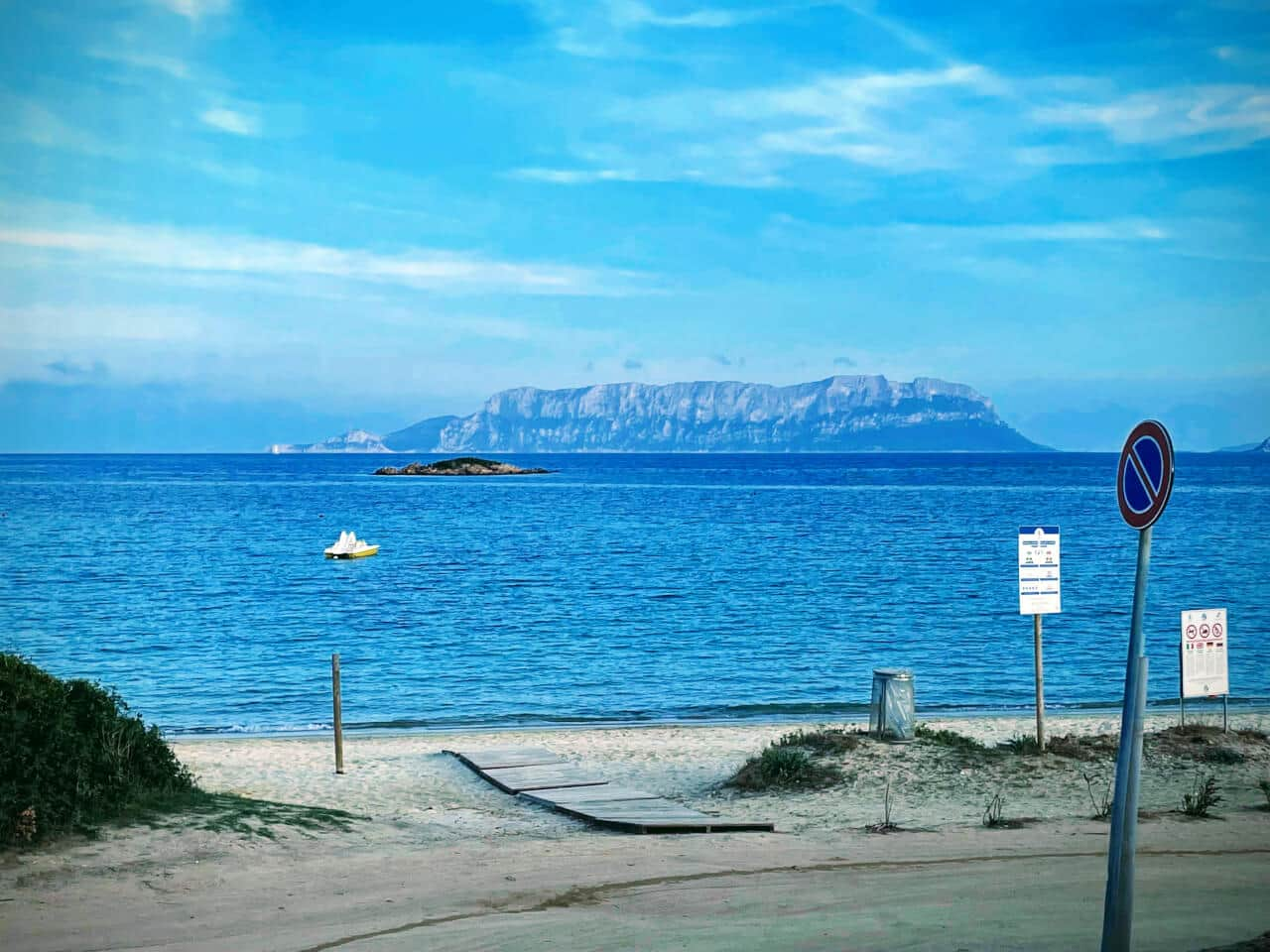
Beach and rocks near Pittulongu, Olbia, north-east Sardinia. Foto RENTAL12.
RENTAL12 · Lion Development SRL · IUN F1530 / CIN IT090047B4000F1530 · 4.9★ from 2,000+ 5 star reviews across platforms · Privacy