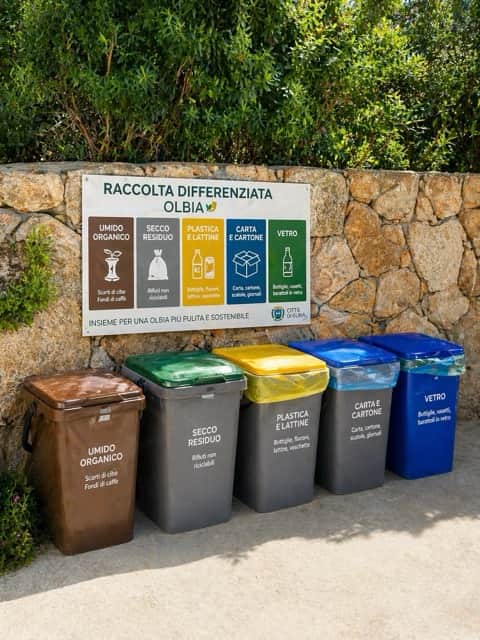
Separating garbage in Olbia — the five UNI 11686 colour-coded bins used across Sardinia · Photo RENTAL12
Sardinia Recycling Guide — How Trash, Bins & Collection Work for Holiday Guests (Olbia & Golfo Aranci)
Sardinia hit 76.6% source-separated recycling in 2024 (ISPRA 2025 report) — third place in Italy. Five bin colors, two towns, an odd/even-week calendar, and no bottle deposit. Here is how the Italian system actually works, and why your professional host handles trash pickup for you.
Last updated: April 2026 · Sources: ISPRA, De Vizia Olbia, De Vizia Golfo Aranci, D.Lgs. 152/2006, UNI 11686
The Italian five-color waste system at a glance
Italian household waste is regulated by D.Lgs. 152/2006 (the Testo Unico Ambientale, Italy's environmental code). In 2017 the UNI 11686 national standard unified bin colors across the country, and most of Sardinia has transitioned to porta-a-porta (door-to-door) collection with chip-coded household bins called mastelli. Street dumpsters have disappeared from tourist areas.
Five waste streams apply nationwide — but individual municipalities can adapt local bag colors, and Golfo Aranci is one of the places where that adaptation catches visitors off guard.
Legal basis: D.Lgs. 152/2006 (Testo Unico Ambientale) and UNI 11686 (2017). Italy's target is 65% recycling by 2035 under EU Directive 2018/851 — and it hit 67.7% already in 2024.
Is there a bottle deposit in Italy? The honest 2026 answer
Italy has no mandatory national deposit-return scheme (DRS) for PET, aluminum or glass — no 5¢ or 10¢ refund like the 10 US bottle-bill states (Oregon, Michigan, California, New York, Connecticut, Iowa, Maine, Massachusetts, Vermont, Hawaii), and no €0.25 refund like Germany. As of April 2026.
Italy runs a consortium-led system instead. Conai (Consorzio Nazionale Imballaggi) coordinates six material streams, including Corepla for plastic packaging and Coreve for glass. PET recycling rates run around 73% according to Conai — a deposit-return scheme has been debated multiple times but never enacted into law.
The only voluntary alternative is the Coripet compactor network: over 800 reverse-vending machines at supermarkets (Conad, Coop, Esselunga, some Eurospin locations) that give points or store discounts for empty PET bottles. The target is 5,000 machines by the end of 2026. No cash refund, no per-bottle nickel.
Don't stockpile empty water bottles expecting a deposit refund — there is none. Drop plastic bottles into the yellow bin (plastica e metalli) and glass into the green bin (vetro). If you want to recycle actively, Coripet machines are at most larger Sardinian supermarkets (Olbia, Sassari, Cagliari); the Coripet app shows the nearest one.
Note: The 2021 "Legge Semplificazioni" law opened the legal path for a DRS, but the implementing decree has never been issued. The debate continues — as of 2026, no scheme is live.
Recycling in Olbia — De Vizia, odd/even weeks & the Ecocentro
The municipality of Olbia (Sassari province, Gallura region) contracts De Vizia Transfer S.p.A. for waste collection. The entire city has moved to porta-a-porta door-to-door pickup. Each household gets a zoned PDF calendar with an odd/even-week (pari/dispari) system — collection days rotate weekly between even-numbered and odd-numbered ISO weeks.
A full system overhaul runs through November 2026: new chip-coded mastelli, updated TARI database, new master calendar. Phase 2 started on April 13, 2026; full switchover is set for November 1, 2026.
Through late 2026 Olbia's calendar is mid-rollout. Every street has its own pickup rhythm. The currently valid plan lives with your host — don't trust older online sources or generic advice.
Five streams, five chip-coded mastelli
Olbia follows the national UNI 11686 color code (see table above). Each household has five color-coded chipped bins:
- Blue — Carta e cartone (paper)
- Yellow — Plastica e metalli (plastic and metal, light multi-material)
- Green — Vetro (glass)
- Brown — Organico / Umido (organic food waste, in compostable bags)
- Gray — Secco indifferenziato (non-recyclable residual)
Additional on-call pickups: sfalci (garden trimmings) and pannolini/pannoloni (diapers). Put-out window: after 10:00 PM the night before, latest 5:00 AM on pickup day. Bins must be retrieved after collection.
Ecocentro Comunale — Via Arabia Saudita
Address: Via Arabia Saudita, Settore 6 Industrial Zone, 07026 Olbia
Hours: Oct–May Mon–Sat 6:30 AM–7:30 PM, Sun 7:00 AM–1:00 PM · Jun/Sep Mon–Sat 6:00 AM–8:00 PM · Jul–Aug Mon–Sat 6:00 AM–10:00 PM
Access: valid ID plus Italian health card (tessera sanitaria) or equivalent. One drop-off per household per day, closed-toe shoes required. Utenze turistiche temporanee (temporary tourist users) are admitted only with ID and proof of TARI registration for the rental unit.
Official source: De Vizia Olbia — Ecocentro Comunale (English page of the waste contractor, verified 2xx).
Recycling in Golfo Aranci — swapped colors & summer/winter calendar
Golfo Aranci (small town north of Olbia) is also serviced by De Vizia, through the separate operating entity deviziagolfoaranci.it (customer service 800 99 29 99). Collection happens daily via porta-a-porta with a fixed weekly calendar that switches between summer (Jun 1–Sep 30) and winter (Oct 1–May 31).
Golfo Aranci uses locally color-coded bags that diverge from UNI 11686: yellow is for paper here (national: plastic), and blue is for glass and metals (national: paper). Sorting by the national color code here will put everything in the wrong bag.
The printed calendar and bag colors inside your rental are binding — not what you may have seen in Rome, Florence, Venice or another Italian trip.
Summer weekly calendar (Jun 1–Sep 30)
Winter (Oct 1–May 31): same Mon–Sat structure, no Sunday pickup. Put-out window: after 10:00 PM the night before, latest 5:00 AM on pickup day. Diapers: only between 12:00–1:00 PM.
Ecocentro Golfo Aranci — Parcheggio "La Piccola"
Address: Parcheggio "La Piccola", Golfo Aranci (temporary 2026 location).
Hours: Mon–Fri 8:00 AM–1:00 PM / 2:00 PM–6:00 PM, Sat 8:00 AM–1:00 PM, closed Sunday.
Access: free but restricted to "utenze domestiche residenti nel comune di Golfo Aranci, stabilmente o stagionali" — registered residents or seasonal residents only. Tourists are not allowed. Attempting a drop-off will get you turned away at the gate.
Official source: De Vizia Golfo Aranci — Calendario Domestico (verified 2xx).
Why your host handles the trash
An English-speaking guest renting an apartment in Olbia or Golfo Aranci faces five structural hurdles that make independent waste disposal practically impossible. This is why professional owner-operated rental companies like RENTAL12 absorb the entire waste-handling process as part of the end-of-stay cleaning.
Italy's waste tax (TARI) is tied to registered residential units. Short-stay tourists are not registered users and therefore have no legal standing to use the porta-a-porta service or the Ecocentro independently. Unauthorized disposal exposes you to fines of 100–500€ under D.Lgs. 152/2006.
Olbia's new bins have RFID chips linked to a specific address and TARI account. Putting your bag in a neighbor's bin or the wrong bin is traceable and triggers a contravention notice to the registered user — i.e., your host.
Each street gets a specific pickup rhythm that changes with the ISO week number. Without the current zone PDF (updated roughly quarterly), no visitor can reliably match the right stream to the right day.
Golfo Aranci's Ecocentro is residents-only; Olbia's requires Italian tessera sanitaria or equivalent plus proof of TARI registration. Neither is realistic for a holiday guest.
All municipal signage, bin labeling and the De Vizia calendar PDF are Italian only. Terms like secco indifferenziato, multimateriale leggero, pari/dispari and sfalci assume fluent Italian — a barrier for most international visitors.
Across all 37 RENTAL12 properties, our cleaning team manages all waste sorting and the porta-a-porta handover at the correct time, on the correct day, in the correct color-coded bag. See our sustainability program for the full environmental approach.
Sardinia vs the rest of Italy — where it ranks
ISPRA (Italy's National Institute for Environmental Protection) publishes the annual Rapporto Rifiuti Urbani. The 2025 edition covers 2024 data and ranks Italian regions by source-separated recycling rate. Sardinia's 76.6% is a strong third-place finish.
For US visitors: the US national recycling rate is around 32% (EPA, most recent available data) — so any part of Italy, and especially Sardinia, runs well ahead of US municipal averages. Visitors from Germany (~68%), Austria (~58%) or the UK (~44%) will find Sardinia comparable or better.
Source: ISPRA Rapporto Rifiuti Urbani Edizione 2025 · ISPRA Municipal Waste Report 2025 (verified 2xx).
Five practical tips for visitors
Leaving a bag next to a bin or on the curb at the wrong time is treated as illegal dumping — D.Lgs. 152/2006 fines run 100–500€ and local authorities do enforce.
Keep separate bags inside the rental for paper, plastic/metal, glass, organic, and residual. Your host will handle the final placement in the right color-coded mastello on the right day.
If your rental provides printed bags, use those. Golfo Aranci's local yellow/blue swap is a common trap for visitors who sorted correctly in other Italian cities.
Want to actively recycle? Coripet compactors sit at most Conad, Coop and Esselunga supermarkets in Olbia, Sassari and Cagliari — points or discount, no cash. The Coripet app shows the nearest machine.
Italy has no bottle-deposit scheme in 2026 — empty water bottles, beer bottles and cans go in the standard yellow (plastic/metal) or green (glass) bin, not a deposit machine.
Frequently asked questions
How does recycling work in Sardinia for short-stay guests?
How does Sardinia's household recycling system work for visitors on a short holiday stay?
Sardinia uses door-to-door (porta-a-porta) household collection with five color-coded bins under the national UNI 11686 standard; as a short-stay guest you are not registered with the TARI waste-tax system, so your host handles pickup and disposal for you.
Every Sardinian municipality now uses porta-a-porta collection — the waste truck comes to each household on a scheduled day, not to street dumpsters. Five color-coded bins (called mastelli) cover paper, plastic/metal, glass, organic food waste, and residual. Because tourists aren't registered as TARI-paying households, there's no legal way for a visitor to interact with the pickup system independently. That's why the host pre-sorts, labels and puts out bins on the right day.
What are the five Italian bin colors and what goes in each?
What are the five official Italian recycling bin colors, and what waste goes into each one?
Blue for paper and cardboard, yellow for plastic and metal, green for glass, brown for organic food waste, and gray or black for non-recyclable residual waste — defined by the UNI 11686 national standard.
UNI 11686 (2017) set these colors nationwide to end decades of regional variation. Blue takes all paper and cardboard including Tetra Paks; yellow holds plastic bottles, yogurt cups, aluminum cans and foil; green is glass only (bottles and jars); brown is organic food waste in compostable bags; gray or black is everything else, including diapers and cigarette butts.
Is the bin color code the same everywhere in Italy?
Does every Italian city follow the same bin color code, or do colors change by location?
No — Golfo Aranci uses yellow bags for paper and blue bags for glass, which is the opposite of the national UNI 11686 code, so always follow the printed calendar and bag colors inside your rental rather than what you may have seen elsewhere in Italy.
Under UNI 11686 the nationwide colors are blue = paper, yellow = plastic/metal, green = glass. Municipalities can supply branded bags that use slightly different colors for local operations, and Golfo Aranci is one of the clearest examples in Sardinia. In Rome, Florence, Venice and Naples you will see the national colors; on arrival in a small town, trust the printed calendar and the bag colors in your unit.
Can tourists use the Ecocentro recycling center in Olbia or Golfo Aranci?
Are holiday guests and tourists allowed to drop off waste at the Ecocentro municipal recycling centers in Olbia or Golfo Aranci?
Olbia's Ecocentro on Via Arabia Saudita allows access to registered TARI-paying households with an ID; Golfo Aranci's Ecocentro at Parcheggio La Piccola is restricted to residents only — tourists are turned away at the gate.
Olbia's Ecocentro admits temporary tourist users (utenze turistiche temporanee) but only with ID plus proof of the rental's TARI registration — practically difficult to get on the fly. Golfo Aranci's temporary Ecocentro at "La Piccola" parking lot is explicitly limited to registered residents (stably or seasonal) — there is no tourist-access pathway. Either way, leave the waste with your host.
Does Italy have a bottle deposit like Germany or Oregon?
Does Italy operate a national bottle-deposit return scheme similar to Germany's Pfand or US bottle bills?
No — Italy has no national deposit-return scheme in 2026; PET bottles, aluminum cans and glass go into the standard curbside recycling bins, and a voluntary network of 800+ Coripet PET compactors at supermarkets offers points-based rewards instead of cash refunds.
The 2021 "Legge Semplificazioni" opened a legal path to a DRS but no implementing decree has ever been issued. Italy's recycling system instead runs via the Conai consortium (Corepla for plastic, Coreve for glass, etc.) — PET recycling hits around 73% through curbside collection. Coripet's voluntary 800+ compactor network at major supermarkets rewards PET returns with app points or store discounts, targeting 5,000 machines by end-2026.
Why does my host ask me to leave trash rather than take it out myself?
Why do professional holiday rentals in Sardinia ask guests to leave trash in the apartment rather than put it out themselves?
Short-stay rentals are not registered as TARI waste-tax households, each address has chip-coded bins on an odd/even pickup calendar, all municipal signage is Italian-only, and the local color code in Golfo Aranci differs from the national standard — making independent disposal practically impossible and exposing guests to fines of 100–500€ under D.Lgs. 152/2006.
The TARI waste tax is tied to registered residents and homeowners — as a short-stay guest you are not in the system and have no legal standing to interact with the collection service on your own. Olbia's chip-coded mastelli can trace wrong sorting back to a household, and Golfo Aranci's "yellow = paper, blue = glass" local swap is a trap for visitors. Leaving pre-sorted bags for the host to handle is faster, legally clean, and more accurate.
How good is Sardinia at recycling compared to the rest of Italy?
How does Sardinia's recycling performance compare to other Italian regions and to international averages?
Sardinia reached 76.6% source-separated recycling in 2024, ranking third among Italian regions behind Veneto and Trentino-Alto Adige — well above the national average of 67.7% reported by ISPRA in the 2025 Municipal Waste Report.
ISPRA's Rapporto Rifiuti Urbani 2025 shows Sardinia's 76.6% is far above the US EPA municipal rate (~32%), the UK (~44%), and Austria (~58%), and roughly matches Germany (~68%). Within Italy, only Veneto (~78%) and Trentino-Alto Adige (~77%) rank higher. Southern regions such as Sicily and Calabria remain in the 55–60% range.
What happens if I put trash in the wrong bin or on the wrong day?
What are the legal consequences of incorrect waste sorting or putting out bins at the wrong time in Sardinia?
Italian waste law D.Lgs. 152/2006 provides fines of 100–500€ for incorrect sorting or putting bins out outside the designated time window, and chip-coded mastelli in Olbia can trace violations back to a specific household — another reason to leave trash with your host.
The Testo Unico Ambientale (D.Lgs. 152/2006) is Italy's framework waste law and allows municipal enforcement with fines typically 100–500€ per incident. Local police (polizia municipale) and De Vizia inspectors do spot-check during peak tourist season. Olbia's chip-based traceability means a misplaced bag can be traced to the TARI account — you will not see the fine, but your host will.
A stress-free Sardinia stay includes waste handling
All 37 RENTAL12 properties come with professional cleaning and full trash pickup. You focus on the beach — we handle the mastelli.