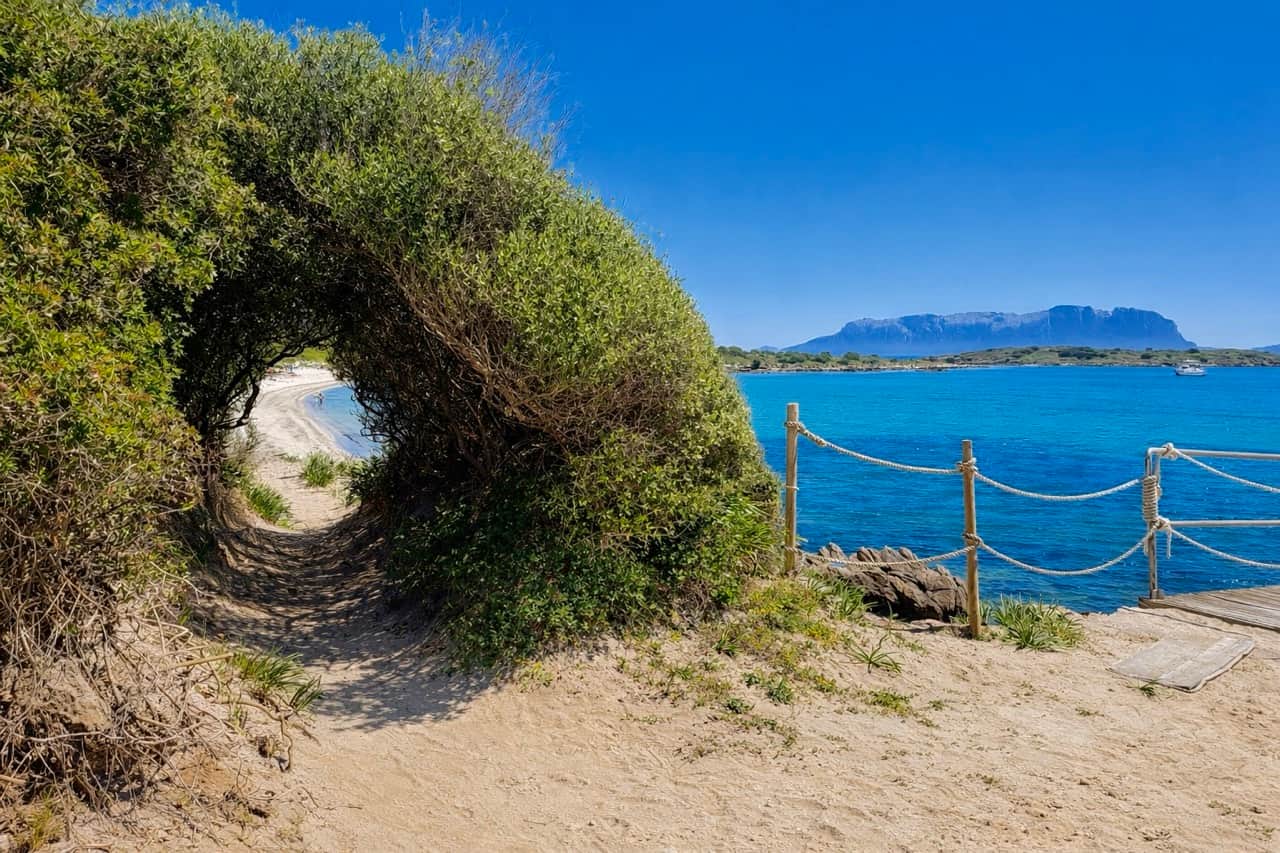
Pittulongu beach near Olbia in early June — sea already at 22°C, beaches still quiet before the July crush. Photo RENTAL12.
Best Time to Visit Sardinia 2026 — Month-by-Month Guide
Air and sea temperatures, rain days, crowd levels and cost levels for every month — verified on the ground by RENTAL12, owner-operated in Olbia since 2021. Last walked: 11 June 2026.

Quick Guide
The best time to visit Sardinia is late April to mid-June and mid-September to mid-October: daytime air temperatures 20–27°C, sea 19–24°C warm enough for swimming, accommodation prices 30–45% below the July–August peak, and crowds materially lighter. July–August give the warmest sea (26–27°C) but the highest prices and beach density. November–March is best for hikers, photographers and city stays — daytime 10–15°C, 50–60% accommodation discounts, occasional heavy rain. The single best month if forced to pick one: early October (warm air, swimmable sea, wine harvest, low prices).
Live tools for your Olbia stay
Real-time helpers that update every day with Sardinia conditions.
Picked your month? Lock in the base.
Sea-front sleeps in Olbia and Golfo Aranci. Owner-operated since 2021 · 2,000+ 5 star reviews · 4.9★.
IUN F1530 · CIN IT090047B4000F1530 · Privacy
1. The 12-month grid — at a glance
Quick answer: Sardinia is mildest and least crowded from April to mid-June and from mid-September to October. The sea is warmest July to September (26–27°C). November to March is rainiest and cheapest. Use the grid below to match a month to your priority — air temperature, sea temperature, rain days, crowd level (1–5), cost level (1–5), and a recommended use of the month.
| Month | Avg high °C | Avg low °C | Sea °C | Rain days | Crowd 1–5 | Cost 1–5 | Best for |
|---|---|---|---|---|---|---|---|
| January | 14 | 6 | 14 | 8 | 1 | 1 | City stays, flamingos, food & wine |
| February | 14 | 6 | 13 | 7 | 1 | 1 | Carnival (Mamoiada, Tempio), almond blossom |
| March | 16 | 8 | 14 | 7 | 1 | 2 | Hiking, wildflowers start, budget travel |
| April | 19 | 11 | 15 | 6 | 2 | 2 | Easter, hiking peak, wildflowers |
| May | 23 | 14 | 18 | 4 | 2 | 3 | Sant'Efisio Cagliari, hiking, first swims |
| June | 27 | 17 | 22 | 3 | 3 | 3 | Beaches without the crush, longest days |
| July | 30 | 20 | 25 | 1 | 5 | 5 | Peak beach season — book 3+ months ahead |
| August | 31 | 21 | 27 | 1 | 5 | 5 | Warmest sea, Ferragosto, max crowds |
| September | 27 | 18 | 25 | 4 | 3 | 4 | Sweet-spot: warm sea, crowds drop |
| October | 22 | 14 | 22 | 7 | 2 | 2 | Wine harvest, late swims, best value |
| November | 18 | 11 | 19 | 9 | 1 | 1 | Flamingos arrive, mushroom & truffle season |
| December | 15 | 8 | 16 | 8 | 2 | 3 | Christmas markets, presepi, mild city walks |
How to read the indexes. Crowd 1 = empty beaches, restaurants walk-in. 5 = fully booked, beach umbrellas touching. Cost 1 = winter rates (apartments from €65/night). 5 = peak August rates (the same apartments at €240–€320/night). Inland (Nuoro, Barbagia) is 2–4°C cooler in winter and 2–3°C hotter in summer than the Olbia coast figures above.
2. Season by season — what each delivers
Quick answer: Spring (April to mid-June) is the year's strongest combination of mild weather, low prices and active outdoors. Summer (mid-June to early September) is peak everything — warmest sea, highest prices, most crowds. Autumn (mid-September to October) repeats spring's value with a warmer sea and wine harvest. Winter (November to March) is for hikers, photographers and city stays.
Spring (mid-March to mid-June)
Spring in Sardinia begins inland with almond blossom in February, becomes the wildflower window in April–May (peak macchia mediterranea bloom and a brief season of wild orchids in the Supramonte), and ends with the first reliable beach days in late May and June. The Sant'Efisio festival in Cagliari (1–4 May) is the largest folk pilgrimage on the island, with traditional Sardinian costume processions worth scheduling a trip around. Easter week shifts each year — book at least eight weeks ahead if it falls in your window. Air temperature 16–27°C, sea climbing from 14°C in March to 22°C by June, prices increasing month by month but still 30–40% below July.
Summer (late June to early September)
Summer is the season Sardinia is famous for and the season every other Italian books for. July and August deliver near-guaranteed sun (1 rain day per month on average), sea at 25–27°C, and 14 hours of daylight, but you pay 80–100% more for accommodation than in May or October, beach umbrellas are charged €25–€40/day on the established lidos, and the popular beaches (La Pelosa, Tuerredda, Cala Brandinchi) impose daily visitor caps. Ferragosto (15 August) is the deepest crowding peak — Italian families book a year in advance for the surrounding two weeks. June and early September are the saner edges of the same warm-sea window.
Autumn (mid-September to October)
Autumn is the locally-known sweet spot. By the second half of September Italian schools are back and the crowd index drops from 5 to 3. Sea temperature stays at 24–25°C through mid-September and 21–22°C through October — still comfortably swimmable. The vendemmia (wine harvest) runs mid-September to mid-October across Vermentino di Gallura (Berchidda, Monti, Arzachena) and Cannonau country (Oliena, Mamoiada). Accommodation prices fall 30–45% from August. October is the single best month for the right traveller — see our dedicated Sardinia in October and September guide for the detailed comparison.
Winter (November to mid-March)
Winter on the Olbia coast averages 10–15°C by day and 5–10°C by night — mild by northern European standards, but not beach weather. Sea drops to 13–15°C. Rain peaks in November (80–100mm in 8–10 wet days) and stays steady through February, then tapers. Sardinia in winter is for hiking the Supramonte and the Costa Verde, photographing flamingo flocks in the Olbia and Cagliari lagoons, walking the Barbagia mountain villages during the Cortes Apertas (Autunno in Barbagia) circuit September to December, and apartment prices 50–60% below peak. For the full weather picture see our Sardinia weather guide.
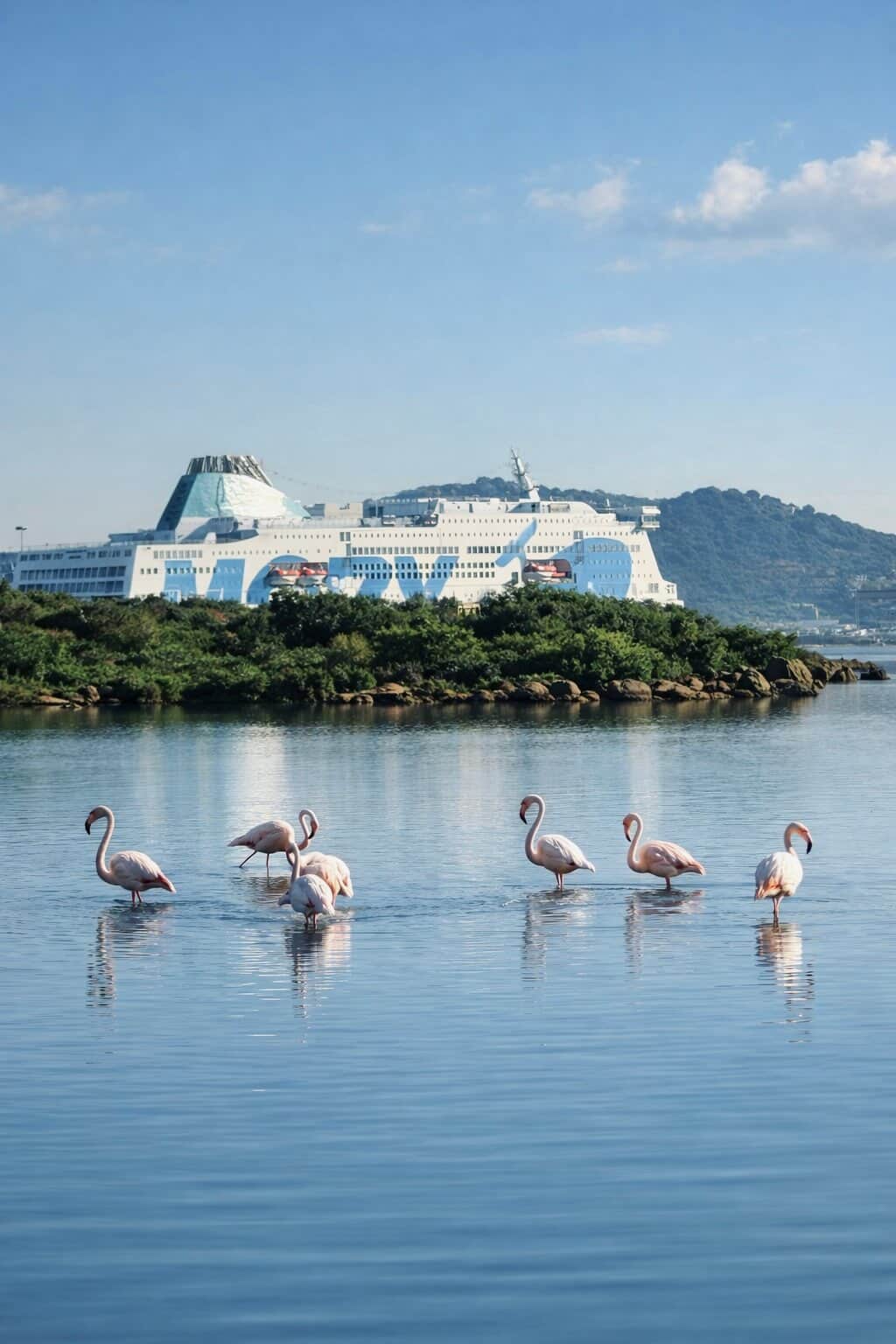
Flamingos in the Olbia lagoon. Peak sightings October to March — one of winter Sardinia's strongest visual rewards. Photo RENTAL12.
3. Best month for…
Quick answer: Beach swimming — August. Family travel — late June and early September. Hiking — late April to mid-May. Wine harvest — late September to mid-October. Romance — May and October. Budget — January, February, March, November. Photography — May (wildflowers), October (light), December–March (flamingos). Sailing — June and September (steady mistral, lighter crowds).
August (sea 27°C) — or late June & early September for the same warm sea with lighter crowds.
Late June and early September — warm sea, long days, but outside the Ferragosto crush.
Late April to mid-May — 18–24°C, wildflowers, Selvaggio Blu trail still passable.
Vermentino mid-to-late September · Cannonau early-to-mid October — book vineyards 6 weeks ahead.
May and October — mild evenings, half-empty restaurants, sunset 19:00–20:30.
January, February, March, November — apartment rates 50–60% below August.
May (wildflowers), October (golden light), December–March (flamingos).
June and September — steady mistral (NW), warm sea, charters 25–35% cheaper than July–August.
4. Sea temperature by month — when can you actually swim?
Quick answer: Most swimmers are comfortable in Sardinian sea water from June (22°C) through mid-October (21°C). The sea is at peak warmth in August at 26–27°C. Hardy swimmers manage May (18°C) and late October (19–20°C). November through April requires a wetsuit (sea 13–16°C).
Sardinia sea temperature by month — northeast coast
- January: 14°C — wetsuit only · February: 13°C (annual minimum)
- March: 14°C · April: 15°C — wetsuit recommended
- May: 18°C — first hardy swims (10–15 min sessions)
- June: 22°C — comfortable for most adults · July: 25°C
- August: 27°C — warmest of the year · September: 25°C
- October: 22°C average (early month) → 19–20°C (late month)
- November: 19°C — last comfortable swims on warm sunny days · December: 16°C
Sardinia's sea-temperature curve runs roughly 4–6 weeks behind the air temperature. May is already warm in the air (23°C) but the sea is still cold (18°C). October is the inverse — the air cools faster than the water, so you can still swim while wearing a jumper after sunset. The sea is consistently 1–2°C warmer along the south coast (Chia, Villasimius) than the northeast (Olbia, Costa Smeralda), and 1–2°C warmer along the east coast in May–June than the west.
A daily 12:00 UTC sea-surface temperature is published by the Italian Civil Protection (Protezione Civile) via Copernicus Marine — the colder Boreas (north / mistral) winds in spring can drop coastal water by 2–3°C overnight. Late-October swimming is more reliable on sheltered south-facing bays (Cala Sassari, Cala Brandinchi) than on north-facing exposures (Pittulongu in a north wind). Match the beach to the wind with our live wind & beaches tool.
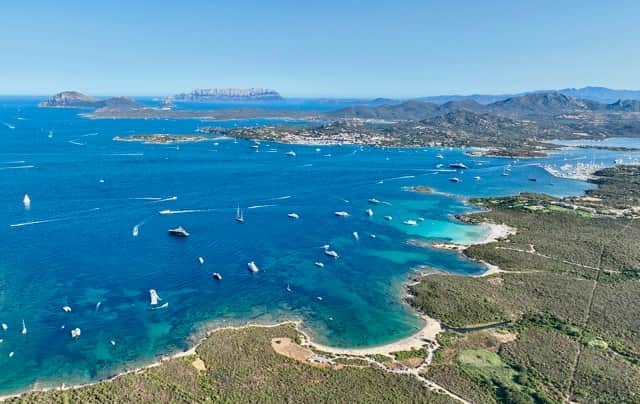
Porto Rotondo bay from the air — the high-summer postcard view of Sardinia’s peak season (July to early September). Photo RENTAL12.
5. Peak season, crowds, costs and 2026 deals
Quick answer: Sardinia’s peak season (July–August) is 80–100% more expensive than May or October, with the deepest week being 10–25 August. Book July–August accommodations at least 3–4 months ahead, May and September 6–8 weeks ahead, and November–March can usually be booked 2–3 weeks in advance. Ferries to Olbia and rental cars sell out faster than apartments — book those first for any peak-summer trip. The best 2026 deals sit in May, early June, late September and October, 30–45% below peak-season rates.
Cost index, concrete numbers
A 1-bedroom RENTAL12 apartment in Olbia old town that costs €65–€85/night in February rises to €105–€135 in May, €175–€220 in late June, €240–€320 in August, and falls back to €110–€140 in October. A 3-bedroom AZULIS villa with private pool in Golfo Aranci runs €280/night in March, €450 in June, €750–€900 in August, €420 in late September. Rental cars at Olbia Costa Smeralda Airport (OLB) follow the same curve: €25/day in January, €110/day in August.
Crowd index, concrete signals
Crowd level 5 (July–August) means: visitor caps enforced at La Pelosa (Stintino) and Cala Brandinchi (San Teodoro); 30-minute waits for unreserved restaurants in Costa Smeralda; ferries to La Maddalena sold out 48 hours in advance; ZTL traffic-limit fines spike in Olbia old town. Crowd level 1 (November–March) means walk-in dining everywhere, free beach umbrellas if they're still set up, and parking on Corso Umberto.
Booking lead time by month
- August (Ferragosto window 10–25 Aug): Book 4–6 months ahead. Premium villas often booked 9 months out.
- July and early September: 3 months ahead for apartments; 4 months for villas with pool.
- June and late September: 6–8 weeks ahead.
- May and October: 4–6 weeks ahead.
- November to March: 1–3 weeks ahead is usually fine; check Christmas/New Year (book 4 weeks ahead for those).
- Easter week: Book 8 weeks ahead (variable date — check Easter dates for your travel year).
Best time to visit Sardinia for deals in 2026
The strongest 2026 deals sit just outside peak season: May, early June, late September and October run 30–45% below July–August rates for the same apartments, and November–March runs 50–60% below. Booking direct cuts OTA commission out of the price — check live availability for current seasonal offers across all 37 owner-operated properties in Olbia and Golfo Aranci.
6. Festivals, harvest and cultural calendar
Quick answer: Sardinia's cultural calendar has four anchor moments: Carnival (February — Mamoiada Mamuthones masks, Tempio Pausania); Sant'Efisio in Cagliari (1–4 May, the largest folk pilgrimage); the vendemmia and harvest festivals (mid-September to mid-October); and Autunno in Barbagia / Cortes Apertas (Sept–Dec, mountain villages opening their courtyards to visitors).
Sardinia event calendar — when to plan around
- Late January – February (Carnival): Mamoiada (Mamuthones & Issohadores masks), Tempio Pausania, Bosa.
- Holy Week (March/April, variable): Cagliari, Alghero, Iglesias Settimana Santa processions.
- 1–4 May (Sant'Efisio, Cagliari): The biggest folk pilgrimage on the island — 300+ traditional costumes, traccas, horse parades.
- Late May / early June (S'Ardia, Sedilo): 6–7 July equestrian race honouring Constantine; book the surrounding area 3 months ahead.
- July – August: Live music festivals, Time in Jazz (Berchidda, mid-August), Cabudanne de Sos Poetas (Seneghe).
- 14–16 August (Ferragosto): Italian summer peak — fireworks at Cala Gonone, beach concerts, deepest week of crowding.
- Mid-September to mid-October (Vendemmia): Vermentino harvest first (Gallura), then Cannonau (Barbagia). Berchidda, Monti, Mamoiada, Oliena host harvest festivals.
- September to December (Autunno in Barbagia / Cortes Apertas): Weekly village openings in the Barbagia mountains — open courtyards, traditional crafts, harvest food. Verify the 2026 calendar at cuoredellasardegna.it.
- December (Christmas): Presepi viventi (living nativity scenes) in Iglesias, Cuglieri; Christmas markets in Alghero, Cagliari, Olbia.
If a specific festival is the trigger for your trip, book accommodations as soon as the diocesan or regional calendar publishes dates — Sant'Efisio and Time in Jazz both push Cagliari and Berchidda accommodation prices up 60–80% for their weekend.
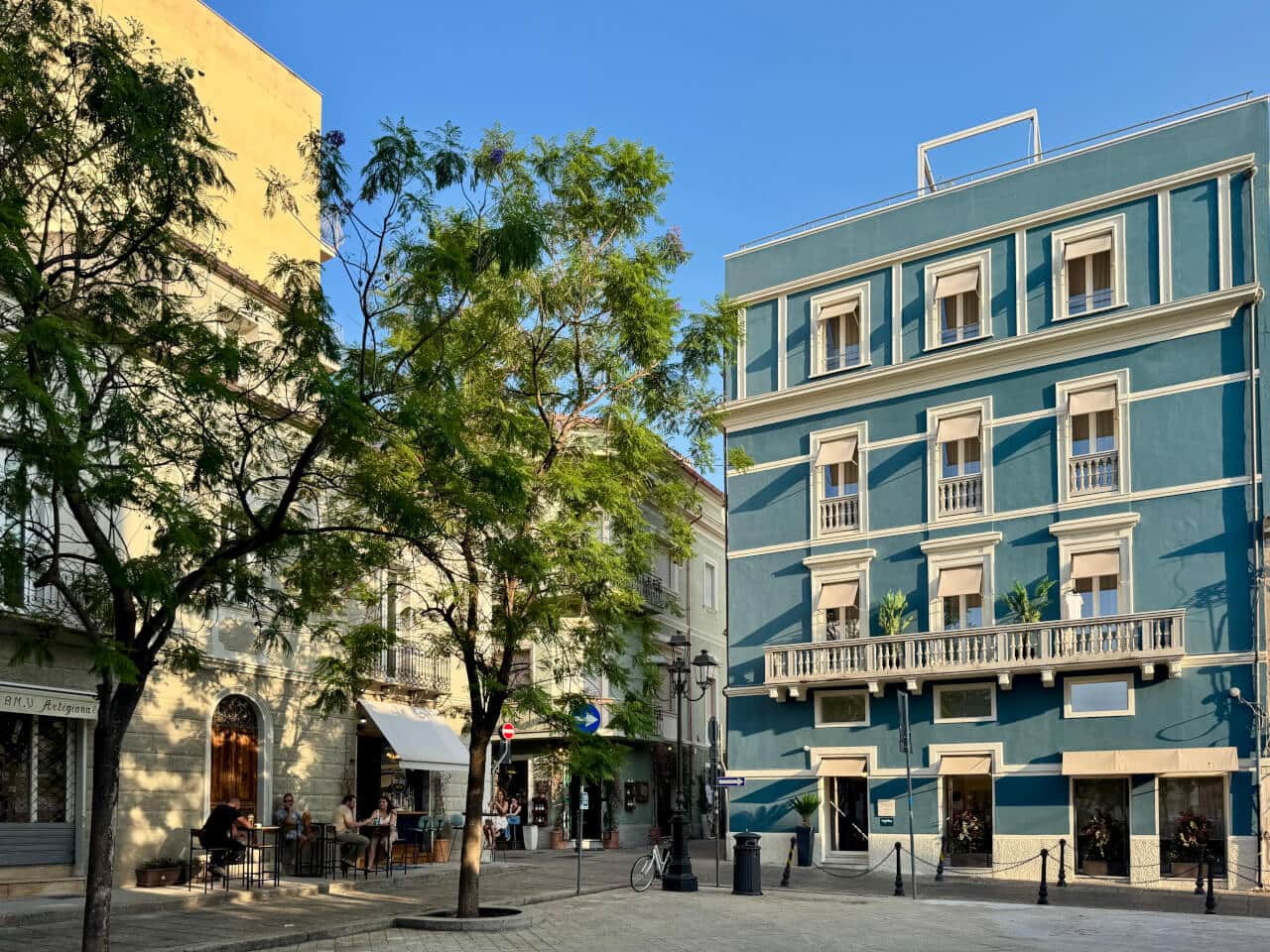
Olbia’s historical centre square — the inland anchor for winter and shoulder-season city stays when the beaches are quiet. Photo RENTAL12.
7. Related guides — weather, October & September detail
Quick answer: This page is the year-round overview. For monthly weather depth (Aeronautica Militare data, microclimate by coast) see our Sardinia weather guide. For the autumn sweet spot in detail — September vs October side-by-side — see our Sardinia in October and September guide.
Sardinia weather guide
Full monthly temperatures, rainfall, sea, wind, microclimate by coast — Aeronautica Militare data.
Sardinia in October & September
The shoulder-season deep dive — swimming, wine harvest, beaches, week-by-week breakdown.
Olbia destination guide
Where to base, what's open by season, how to use Olbia as a year-round hub.
Art by Anastasia Duke
Sardinia-inspired paintings displayed in the AZULIS apartments — a rainy-day cultural anchor.
8. Frequently asked questions
What is the best time to visit Sardinia?
When is the best time of year to visit Sardinia for the right balance of weather, price and crowds?
The two best windows are late April to mid-June and mid-September to mid-October — daytime temperatures 20–27°C, sea 19–24°C warm enough for swimming, accommodation prices roughly 30–45% below the July to August peak, and beaches measurably less crowded.
If forced to pick a single month, choose early October: air 22–24°C, sea still 22°C from the summer heat reservoir, vendemmia in full swing, accommodation prices already 40% below August, and the beaches handed back to locals and a small number of in-the-know visitors. Late May is the close second — wildflowers still out, sea reaching 18–20°C, similar pricing. Avoid the deepest week of crowding, 10–25 August, unless school holidays force you into it.
What is the warmest month in Sardinia?
Which month has the highest air and sea temperatures in Sardinia?
August is the warmest month in Sardinia, with average daily highs of 30–32°C in Olbia and the coast, peaks above 35°C inland, and sea temperatures of 26–27°C — the warmest water of the year.
Inland Sardinia (Nuoro, Mamoiada, Macomer) is regularly 3–5°C hotter than the Olbia coast in August — peaks of 38–40°C on still days are not unusual. The east coast benefits from the cooling sirocco-mistral cycle and rarely passes 33°C. Nights stay warm: minima 21–23°C in coastal towns, meaning open balconies through the night and air-conditioning recommended for sleeping. Sea temperature peaks 5–10 August in the bays around La Maddalena and Costa Smeralda at 27°C, falling 1°C per week from mid-September onward.
When is the sea warmest in Sardinia?
In which months is the Sardinian sea warm enough for comfortable swimming?
The sea around Sardinia is warmest from late July through mid-September, peaking at 26–27°C in August. June reaches 22–23°C, October stays at 21–22°C — both are comfortable for swimming without a wetsuit.
May and November are the marginal months. May at 18°C is wakeup-cold for most swimmers but fine for a 10–15 minute dip on a sunny afternoon. November at 19°C can still feel warm by contrast with chilly air. December through April requires a 3mm wetsuit for comfortable swimming. Sheltered bays on the south coast (Tuerredda, Chia) warm 1–2°C above the northeast average; deep exposed gulfs (Orosei) hold their summer warmth a week longer into October.
Can you swim in Sardinia in October?
Is the sea warm enough to swim in Sardinia in October?
Yes — sea temperature in October averages 22°C early in the month and 19–20°C by late October, warm enough for most swimmers. Air temperature is typically 22–25°C with sunny days, though the first autumn rains usually arrive in the second half of the month.
Early-October swimming is essentially identical to a late-May trip but inverted: the sea is warm and the air is cooling, instead of the air-warming-sea-still-cold pattern of May. By mid-October expect the first proper rain front of the autumn — a 24–48 hour wet window typical, then a return to sunshine. Pack a light long-sleeve for sundown and a swimsuit you don't mind cooling slightly between dips. For the week-by-week October breakdown see our October & September guide.
Is Sardinia worth visiting in winter?
Is it worth visiting Sardinia in winter — November to March?
Yes for hikers, photographers, city breaks and food-and-wine trips — daytime temperatures stay 10–15°C in Olbia, accommodation prices drop 50–60% from peak, and inland villages reveal a non-tourist Sardinia. Beach swimming is not realistic (sea 13–15°C); pack waterproofs for occasional heavy showers.
Winter Sardinia rewards travellers who want the island for itself rather than its summer reputation. Hiking the Supramonte and the Selvaggio Blu is at its best in December–February when the heat is gone and the water sources are full. Mamoiada's Mamuthones masks (Carnival, February) are one of Europe's most striking pre-Christian rituals. Restaurants serve seasonal game (wild boar, hare) and the truffle/mushroom season in Anela and Bono runs October–January. Flights to Olbia thin out — Ryanair and easyJet keep a skeleton service via Bergamo and Stansted; consider Cagliari (CAG) which has better winter connections. Days are short (sunset 17:00 in December) so plan inland trips early.
What is the rainiest month in Sardinia?
Which is the wettest month of the year in Sardinia?
November is the rainiest month in coastal Sardinia, averaging 80–100mm across 8–10 rain days near Olbia. December and January are nearly as wet. Rain typically falls as short heavy showers, not all-day drizzle — most winter days still deliver several hours of sun.
Sardinia's total annual rainfall is 500–600mm on the coast and 700–1000mm in the central mountains (Gennargentu) — much drier than mainland Italy. The "rainiest month" label means more wet days, not constant rain: even in November, 18–20 days out of 30 are dry. The pattern is short intense storms (15–60 minutes), often passing in mid-morning and clearing by lunchtime. Carry a compact waterproof, not a heavy raincoat. The driest months by a wide margin are June, July and August — 1–3mm per month, often zero rain for 6 weeks.
Should you visit Sardinia in July or August?
Is it a good idea to visit Sardinia in peak summer — July or August?
Only if school holidays make it unavoidable. July and August deliver guaranteed sun and warm sea (26–27°C), but you pay 80–100% more for accommodation than May or October, beaches and restaurants are crowded, and ferries and rental cars must be booked 3–4 months ahead.
If you have to come in peak summer, three tactics help. First, book everything 4 months ahead — apartments, rental car, ferries to La Maddalena, restaurant tables in Costa Smeralda. Second, swim at dawn (06:30–08:30) and visit beaches with visitor caps (La Pelosa, Cala Brandinchi) on weekday early mornings or after 16:30. Third, base inland or in a quieter village (Posada, Lula, San Pantaleo) rather than the trophy resorts — you trade 15 minutes of driving for 50% lower prices and a saner pace.
When is the best time to visit Sardinia with a family?
Which months are best to visit Sardinia with children?
Late June and early September are the strongest family windows — sea is reliably warm (23–25°C), days are long, but the August school-holiday crush is avoided. Easter week and late April also work well for younger children if beach swimming is not the main goal.
Italian families holiday in compact bursts — the deepest family crowding is 1–25 August, with a secondary peak Easter week. UK and German school holidays are longer and the families spread out across June–September. For toddlers, the rotated beach umbrellas, shallow Mediterranean (most local beaches stay knee-deep for 30+ metres), and predictable warm sea make Sardinia an excellent first beach holiday. The villa-with-pool option (AZULIS Athos, AZULIS Aramis in Golfo Aranci) removes the cost-per-cone and the beach-umbrella battle from the equation for younger kids.
When is the cheapest time to visit Sardinia?
When is the cheapest time of year to visit Sardinia?
November through March is cheapest — accommodation prices are 50–60% below August, flights to Olbia Costa Smeralda are at their lowest, and rental cars cost roughly half. Late September and May are the cheapest months still inside swimming season.
A €240/night August villa often runs €95/night in late November and €110 in early March. Flights from London Stansted to Olbia (OLB) range £25–£45 in winter vs £180–£240 in August. Rental cars (compact) drop to €25–€35/day. The trade-off: short days (sunset 17:00 in December), some beach-bar restaurants closed, fewer rental car desks open at OLB. February has a hidden cost spike for Carnival week in Mamoiada — book that one ahead even at low season. May and late September are the "value sweet spot" — mostly summer weather at mostly winter prices.
When is Sardinia's wine harvest?
When does the wine harvest (vendemmia) take place in Sardinia?
Sardinia's vendemmia runs mid-September to mid-October. Vermentino di Gallura is picked first (mid-to-late September), Cannonau follows in early-to-mid October. Berchidda, Monti, Arzachena and Oristano host harvest festivals through this window.
Vermentino di Gallura DOCG (the only Sardinian DOCG) is picked first because the white grape ripens faster. The Gallura cooperatives (Cantina del Vermentino in Monti, Cantina di Berchidda) open vineyards for tastings, harvest meals and grape-pressing demonstrations through late September. Cannonau (Sardinia's most famous red, classified for its high-resveratrol Blue Zone link) is picked early-to-mid October in Oliena, Mamoiada and Dorgali. Both windows are also the easiest time to book restaurants: locals are working the harvest, tourists have gone home, and the new oil + new wine flight is on every menu.
Is spring a good time for hiking in Sardinia?
Is spring a good time for hiking in Sardinia — and which trails are open?
Yes — late March to mid-May is the best hiking window in Sardinia. Temperatures 16–24°C avoid summer overheating, wildflowers peak in April and early May, rainfall is dropping, and the long-distance Selvaggio Blu and Supramonte trails are open with cool morning starts.
The 5-day Selvaggio Blu coastal trek (Pedra Longa to Cala Sisine) is most often guided in April–May and again in late September–October. Summer hiking is possible but means 05:00 starts to beat the heat; July–August daytime hiking on exposed granite is genuinely risky. Late October and early November add a second hiking window — cooler, water sources still active, fewer wasps. Always check water sources before multi-day routes — many summer fountains dry by mid-July. Closed walking shoes plus 2L water per person on any inland trail.
When do flamingos arrive in Sardinia?
When can you see pink flamingos in Sardinia?
Pink flamingos are visible in the Olbia and Cagliari lagoons from October through April, with peak numbers December to March. They are a year-round resident colony in Cagliari (Molentargius) but seasonal in the northern lagoons around Olbia.
The Olbia lagoon, visible from the road into Olbia from the airport, hosts flocks of 200–600 birds at peak. Best viewing is early morning (07:30–09:30) and late afternoon (16:30–sunset) from the salt-pan paths between San Teodoro and Olbia. The Cagliari Molentargius wetland is the breeding colony — birds present year-round, with the chick-rearing season in summer. Bring a 200mm+ lens and patience.
Plan your Sardinia month — from the right base.
37 owner-operated properties in Olbia and Golfo Aranci. Owner-operated since 2021 · 2,000+ 5 star reviews · 4.9★.
IUN F1530 · CIN IT090047B4000F1530 · Privacy