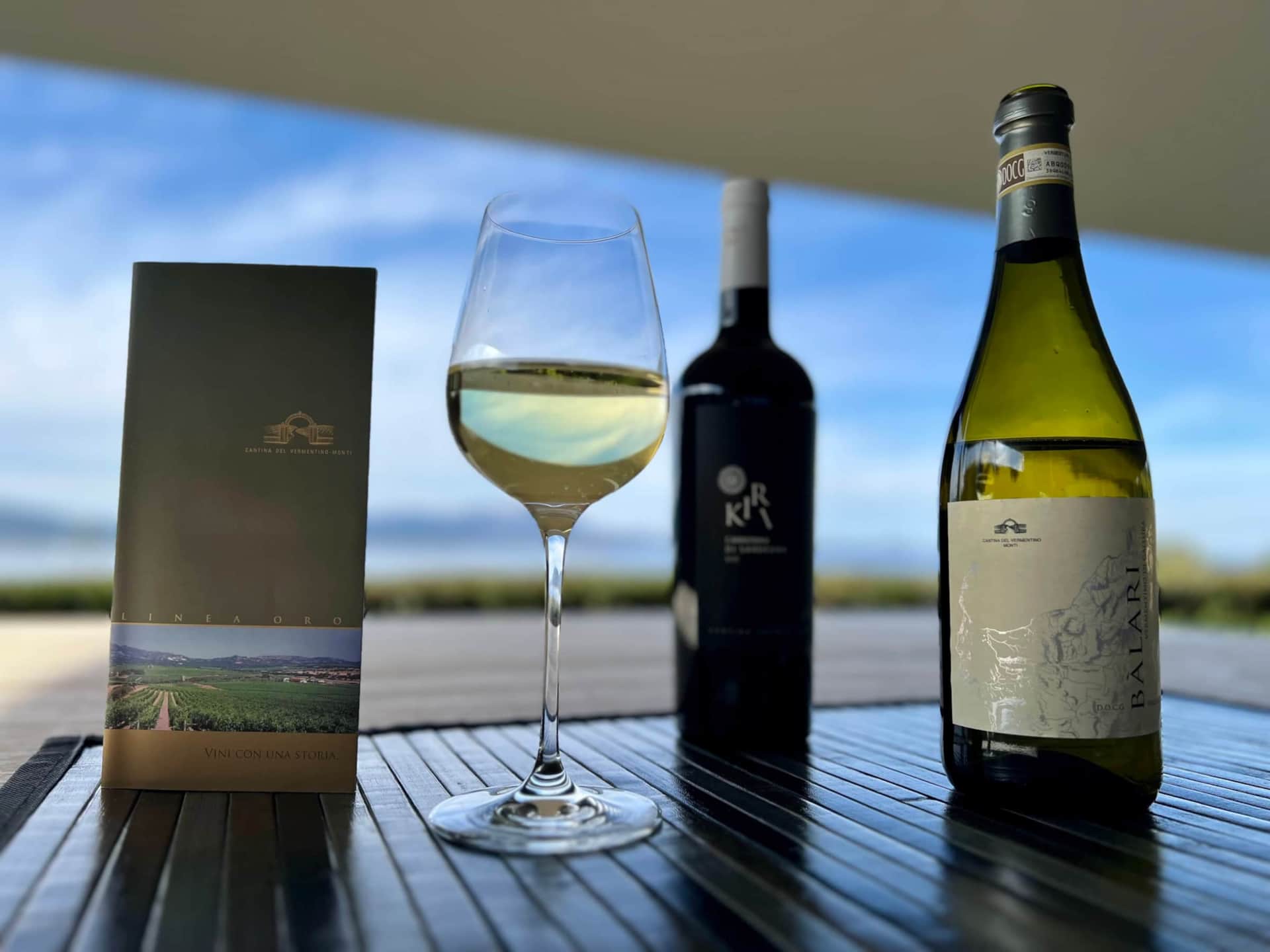
Vermentino di Gallura DOCG — the only DOCG wine of Sardinia. Photo RENTAL12.
Sardinian Food: Traditional Dishes, Blue Zone Diet & Wine
Twelve named dishes, two PDO wines and the documented Blue Zone diet — explained by Olbia-based locals who eat them every week.

Lives and works in Olbia’s old town since 2021; eats at the restaurants named below every week.
Quick Guide — Sardinian Food in 60 Seconds
Sardinian food is mountain shepherd cuisine (pane carasau, pecorino sardo, porceddu, seadas) on the inland side and Mediterranean seafood (bottarga di muggine, fregola con arselle, ricci di mare) on the coast. Two PDO wines anchor every meal: Cannonau (red, Grenache — high polyphenols, Blue Zone-linked) and Vermentino di Gallura DOCG (white, the only DOCG of Sardinia, 1996). The Ogliastra and Barbagia inland provinces form one of the world’s five documented Blue Zones — identified by Pes & Poulain (2004), popularised by Dan Buettner (National Geographic 2008).
Live tools for your Olbia stay
Real-time helpers that update every day with Sardinia conditions.
Eat like a local — stay in the old town
37 apartments inside Olbia’s centro storico, 90 seconds from the best trattorias.
What Sardinian food really is
Quick answer: Sardinian food is two cuisines on one island. Inland is pastoral — shepherd bread (pane carasau), pecorino, slow-roasted lamb and porceddu, hand-pleated culurgiones. The coast is Mediterranean seafood: fregola con arselle, bottarga di muggine, spaghetti ai ricci di mare. Both meet around Cannonau wine, mirto liqueur and bitter Sardinian honey at the end of the meal.
Visitors who arrive expecting “Italian food” quickly notice Sardinia is its own world. The island spent two and a half thousand years swapping rulers (Phoenicians, Romans, Vandals, Byzantines, Pisans, Genoese, Aragonese, Spanish, Savoyards) without losing its inland shepherd culture — and that culture, not Tuscan or Roman cooking, defines the table here. The Sardinian language (sardo) has separate words for everyday dishes that don’t exist in standard Italian: culurgionis, malloreddus, su porcheddu, sa fregula, casu marzu.
The coast added a parallel Mediterranean layer — mullet from the Cabras lagoon for bottarga, sea urchins from the rocky north coast for spaghetti ai ricci, tuna from the western tonnare, and the granite-soil Vermentino vineyards of Gallura. A typical week in our Olbia kitchen looks like: Monday pasta with bottarga, Tuesday fregola con arselle, Wednesday culurgiones with tomato and sage, Thursday grilled pecorino sardo with myrtle honey, Friday spaghetti ai ricci, Saturday porceddu lunch out, Sunday seadas with corbezzolo honey.
12 traditional Sardinian dishes to try
Quick answer: The twelve canonical dishes — pane carasau, culurgiones, fregola con arselle, malloreddus alla campidanese, porceddu, agnello con carciofi, spaghetti alla bottarga, spaghetti ai ricci di mare, zuppa gallurese, casu marzu (Gallura specialty), pecorino sardo and seadas — cover every region from Gallura in the north to Cagliari in the south. The five with their own H2 below are the ones you’ll see most often on Olbia menus.
Slow-roasted suckling pig with myrtle — the island's signature.
Potato-and-mint pasta with the ear-of-wheat pleat.
Toasted semolina pearls with clams — the coast at its best.
Saffron gnocchetti with sausage ragù.
Lamb with wild artichokes — spring classic.
Grey-mullet roe grated over pasta with lemon.
Sea-urchin pasta — March-April peak season only.
Layered bread and pecorino casserole — pure Gallura.
EU-restricted live-larvae cheese — private only.
Sheep cheese, fresh (dolce) or aged (maturo).
Paper-thin twice-baked shepherd flatbread.
Fried cheese pastry with bitter honey — the canonical dessert.
Pane carasau — music-paper shepherd bread
Quick answer: Pane carasau is a paper-thin twice-baked Sardinian flatbread — nicknamed carta da musica (music paper) because it’s almost transparent and crackles when broken. Originally made by shepherds in the Barbagia highlands to keep for months, it’s still the bread on every Sardinian table today. Brushed with olive oil and rosemary it becomes pane guttiau; layered with broth, egg and pecorino it becomes pane frattau.
The dough is plain — semolina flour, water, salt, sourdough — but the technique is unusual. It’s rolled into thin discs, baked once at very high heat until it inflates like a pillow, then split horizontally with a knife into two thinner discs, and baked a second time until rigid and golden. The split-and-rebake is what gives the bread its shelf life: with no moisture left, it keeps for up to six months in a tin. Highland shepherds used to take a month’s supply when they walked the flocks to summer pasture in the Gennargentu mountains.
How to eat it: snap a sheet, brush with olive oil and sea salt for the simplest aperitivo with a glass of Vermentino. For pane frattau, dip whole sheets in hot tomato broth until just soft, layer with grated pecorino, repeat three times, top with a poached egg. It is a Nuoro / Barbagia farmhouse classic and a regular Sunday lunch starter at Sardinian agriturismi.
Culurgiones — the ear-of-wheat pasta dumpling
Quick answer: Culurgiones (also culurgionis, kulurzones) are hand-pleated Sardinian dumplings stuffed with potato, mature pecorino, mint and garlic — closed with a distinctive ear-of-wheat pleat (spighittu) that takes years to master. Originally from the Ogliastra province on the east coast, they’re PGI-protected as Culurgionis d’Ogliastra and traditionally served with butter and grated pecorino, or simple tomato and sage.
The filling varies village by village. Around Lanusei and Arzana (Ogliastra) the ratio is roughly 60% potato, 25% aged pecorino, 10% fresh mint, plus salt, pepper and a hint of garlic. Up the road in Barbagia the cheese ratio jumps; further south in Sarrabus you’ll find versions with grated lemon zest. The pleat — not the filling — is what makes a culurgione a culurgione: the dumpling is folded over the filling and the edges are pleated by hand into the wheat-ear shape, with typically 14–18 individual pleats. The pleat is also the proof of authenticity: a machine cannot replicate it.
At Olbia restaurants you’ll most often find them served “al pomodoro e basilico” (tomato + basil) or “al burro fuso e salvia” (melted butter + sage). At our partner Stella in Monti they appear as a degustation course with a single dumpling per plate so you can see the pleat properly.
Fregola — toasted semolina pearls
Quick answer: Fregola (Sardinian fregula) is a rough-textured, toasted semolina pasta in 2–4 mm pearls, with a deep golden colour from oven-toasting. The signature dish is fregola con arselle — pearls cooked in a saffron-and-tomato clam broth until they absorb the liquid like a Sardinian risotto. It’s the coast’s answer to inland malloreddus.
The technique is older than dried pasta: semolina is rubbed between palms (the word fregare means to rub), the resulting pearls are dried in the sun, then toasted in a wood oven. The double-treatment — sun-drying and oven-toasting — gives fregola its distinctive nutty flavour, very different from couscous (which is steamed) or Israeli ptitim (which is just baked).
The Cabras lagoon on the west coast supplies the bottarga and the clams (arselle in Sardinian, vongole in standard Italian) that go with fregola. In Olbia, fregola con arselle is on most coastal menus year-round; we like Officina del Gusto’s version (Corso Umberto) and Lo Specchio at the port.
Porceddu — the suckling pig ritual
Quick answer: Porceddu (Sardinian su porcheddu) is a 4–7 kg suckling pig, slow-roasted vertically over a juniper-wood fire for 3–5 hours, then rested on a bed of fresh myrtle leaves that infuse the meat. The skin goes glass-crisp; the meat falls off the bone. It’s the island’s ceremonial dish — reserved for Sundays, weddings, baptisms and Sant’Antonio (17 January).
The fire matters more than the recipe. Traditional cooks use only juniper (ginepro) or olive wood, never resinous pine. The pig is split, fixed to an iron spit (su schidone) and angled toward (not over) the embers so the fat drips away rather than flaring. The pig is rotated every 20–30 minutes for hours; salt is the only seasoning. At the end, the myrtle bed is added and the lid closes — the steam-perfume step is what makes a porceddu Sardinian rather than just “roast pork.”
For an authentic countryside porceddu lunch from Olbia, drive 25–40 minutes inland to an agriturismo in the Monte district. Our partner Stella in Monti serves a full Sardinian degustation including porceddu in its myrtle bed; Sa Mandra near Alghero is the southern equivalent. Plan for a three-hour lunch and don’t schedule anything afterwards.
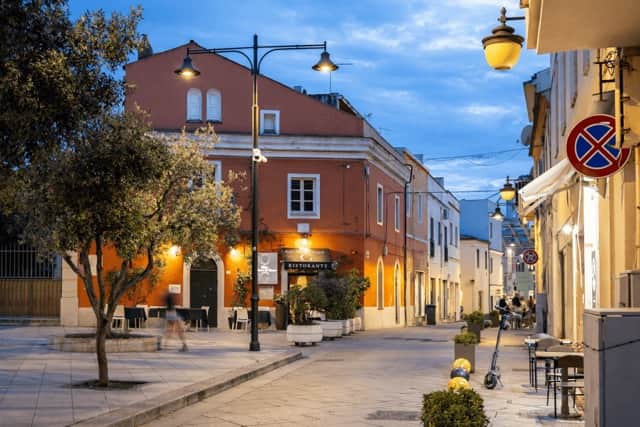
Olbia centro storico at night, near Officina del Gusto and the cluster of trattorias around Corso Umberto. Photo RENTAL12.
Seadas — the canonical Sardinian dessert
Quick answer: Seadas (also sebadas) are large fried pastry pillows filled with young pecorino cheese and lemon zest, drizzled hot with bitter Sardinian millefiori honey or corbezzolo (arbutus) honey. The contrast of warm melted cheese, salty crust, sour lemon and bitter honey is the signature finish to a Sardinian meal — no tiramisu, no cannoli, just seadas.
The cheese used must be young pecorino (1–7 days old) so it melts smoothly without turning rubbery; older pecorino sardo PDO is too dry. The dough is semolina, lard and water; the disc closes over the cheese filling and is sealed with a fork. Frying is in olive oil at around 170 °C for under two minutes — just enough to puff the pastry without cooking the cheese into oil.
The honey is the make-or-break detail. Corbezzolo honey (from arbutus flowers, which bloom in November) is the most prized and the most bitter — about €25/kg at the producer. Millefiori honey is sweeter and more common. Asphodel honey is the third Sardinian classic. Skip seadas served with chestnut or eucalyptus honey — not traditional.
Seafood, bottarga and the lagoon catch
Quick answer: Sardinian seafood pivots on three icons: bottarga di muggine (cured grey-mullet roe from the Cabras lagoon — grated over spaghetti with lemon), spaghetti ai ricci di mare (sea-urchin pasta, peak March-April only), and fregola con arselle (clam-broth pearls). Olbia’s port lands fresh octopus, sea bass and sea bream daily; Cabras on the west coast is the bottarga capital.
Bottarga di muggine is the island’s most expensive ingredient: roughly €180–220/kg whole. The grey mullet are netted in the Cabras and Tortolì lagoons in late summer, the roe sacs are extracted whole, salt-cured for two weeks, pressed flat, then air-dried for three months. The result is a dense amber-orange block that grates like hard cheese. The classic pasta: spaghetti aglio-olio with grated bottarga and a squeeze of lemon at the end — no Parmesan, no butter.
Sea-urchin season is strictly regulated: 1 October to 30 April only (with a 2-year fishing ban currently in force for stock recovery — check local regulations before ordering). Spaghetti ai ricci is white wine, garlic, olive oil and the raw orange roe stirred through hot pasta off the heat. Octopus appears as carpaccio (cooked-then-pressed-then-thin-sliced), in salads with potato and parsley, or grilled whole. Sea bass and sea bream (spigola, orata) are the typical second course — baked in salt crust or grilled, served with a wedge of lemon and nothing else.
Pecorino, fiore sardo and the cheese family
Quick answer: Sardinia produces around 70% of all Italian sheep’s milk and exports the majority to mainland producers of Pecorino Romano. The two PDO cheeses to know are Pecorino Sardo PDO (mild or matured, eaten on the table) and Fiore Sardo PDO (smoked raw-milk, used for grating). Casu marzu — live-larvae cheese — is EU-restricted and never appears on restaurant menus; it’s a private Gallura specialty.
Pecorino Sardo PDO comes in two forms. Dolce (sweet) is aged 20–60 days, soft, creamy, ideal at the start of a meal with pane carasau and figs. Maturo (matured) is aged 4+ months, hard, sharp, table-grated. Fiore Sardo PDO is older and smokier — raw sheep milk, hand-formed in wooden moulds (the “fiore”/flower mark on the rind), salted dry and aged in chestnut-wood lofts above an open fire for 4–12 months. It’s the cheese most often used for grating over malloreddus or culurgiones.
The famous “controversial” cheese: casu marzu. It is a pecorino deliberately colonised by piophila casei fly larvae, who break down the fat into a creamy emulsion. It’s a real product of inland Sardinia (Nuoro / Ogliastra / Gallura) but EU food-safety rules effectively ban its commercial sale — it is only legally consumed in private households. No restaurant in Olbia will serve it; if a tourist menu advertises it, that’s a sign to leave.
Sardinian wines — Cannonau, Vermentino di Gallura DOCG, mirto
Quick answer: Two PDO wines anchor the Sardinian table. Cannonau di Sardegna DOC (red, the Grenache grape) is the everyday red — high-polyphenol, full-bodied, often cited as a Blue Zone factor. Vermentino di Gallura DOCG (white, granite-soil, granted 1996) is the only DOCG-classified wine of Sardinia, and the perfect pour for bottarga, fregola con arselle and grilled seafood. Meals end with mirto — a deep-purple liqueur made from wild myrtle berries.
Cannonau di Sardegna. The island is widely accepted as the original home of Grenache (which the Spanish later took to Aragon as Garnacha). Cannonau is grown island-wide but the historic heartland is Jerzu (Ogliastra), Mamoiada (Barbagia) and Oliena (Nuoro). The wine is full-bodied, 13.5–14.5% ABV, with notes of red cherry, dried herbs, leather. Its polyphenol content is two to three times that of mainland Italian reds, a fact widely cited in Buettner’s Blue Zone work. Pair with porceddu, lamb, aged pecorino, hard cheeses.
Vermentino di Gallura DOCG. The only DOCG (Italy’s top wine classification) on Sardinia, granted in 1996. Made exclusively from Vermentino grapes grown on the granite-and-quartz soils of the Gallura province in the north — the soils between Tempio Pausania, Aglientu, Luras and Berchidda. The wine is bone-dry, crisp, with mineral, citrus and almond notes; serve at 8–10 °C. Producers to know: Cantina del Vermentino (Monti), Capichera (Arzachena), Surrau (Arzachena), Siddura (Luogosanto), Pedres (Olbia). Vermentino di Gallura is also available as Superiore (higher ABV, longer ageing) and Spumante (sparkling) for special occasions.
Mirto. A liqueur made by macerating wild myrtle berries (Myrtus communis) in neutral alcohol for 6–8 weeks, then sweetening with sugar syrup. The colour is deep violet/black; the taste is herbaceous, slightly bitter, with juniper-pine notes. Always served ice-cold (some bottles live in the freezer) in a small shot glass after seadas, as digestivo. White mirto — from the leaves rather than berries — is also produced but less common. Brand notes: Zedda Piras, Lucrezio R., Silvio Carta, Cantina di Calasetta.
Other Sardinian wines worth knowing: Carignano del Sulcis DOC (red, Sulcis peninsula, often compared to old-vine Languedoc Carignan), Vermentino di Sardegna DOC (the island-wide Vermentino, one tier below the DOCG), Vernaccia di Oristano DOC (oxidative-style white, Sherry-adjacent), and Malvasia di Bosa DOC (sweet white, very small production).
The Sardinian Blue Zone diet — what the research actually says
Quick answer: The Blue Zone of Sardinia is the mountainous Ogliastra and Barbagia provinces (Nuoro), identified by demographers Gianni Pes and Michel Poulain in their 2004 paper in Experimental Gerontology as having the highest concentration of male centenarians ever recorded. The pattern was popularised globally by Dan Buettner’s 2005 National Geographic cover story and his 2008 book The Blue Zones. The diet itself is plant-heavy, low-meat, pecorino-cheese-and-Cannonau-wine.
The original Pes-Poulain research mapped the inland villages where men live to 100 at a rate 10× higher than the rest of Italy — centred on the Nuoro province, in particular Villagrande Strisaili, Arzana, Talana, Urzulei, Baunei, Triei, Ulassai. The diet shared across these villages, documented across multiple peer-reviewed studies, is roughly:
- Daily: sourdough bread, pecorino, garden vegetables, wild greens (cardoon, chicory), fennel, fava beans, chickpeas, barley.
- Weekly: small portions of fatty fish, free-range eggs, sausage (sa salsiccia sarda), pasta with tomato.
- Monthly: red meat (usually lamb or porceddu) on celebrations — not daily.
- With every dinner: a small glass of Cannonau (about 150 ml); a slice of pecorino at the end.
- Sweets: rare, mostly honey-based (seadas at celebrations only).
Researchers point to four likely contributors beyond food: (1) lifelong walking on hilly terrain (steep village layouts, daily walks to fields/flocks), (2) tight multi-generational family networks (low loneliness), (3) genetic factors specific to the inland Sardinian population (M26 haplogroup overrepresented), (4) sustained low-stress lifestyle. The Pes-Poulain “Blue Zone” concept later expanded to Okinawa (Japan), Nicoya (Costa Rica), Ikaria (Greece) and Loma Linda (California) — but Sardinia was the first and the male-centenarian density is still unmatched.
Source notes for citation: Pes GM, Poulain M, “Identification of a geographic area characterized by extreme longevity in the Sardinian island,” Experimental Gerontology 2004; Buettner D, “The Secrets of Long Life,” National Geographic November 2005; Buettner D, The Blue Zones, National Geographic Books 2008 (updated 2012, 2023). See also the longer treatment in our Blue Zone Sardinia guide.
How a Sardinian meal actually flows
Quick answer: A traditional Sardinian meal runs five courses over 2–3 hours: aperitivo (Vermentino + pane carasau + pecorino), antipasti (cured meats + olives + bottarga), primo (pasta or fregola), secondo (porceddu, lamb or grilled fish + side), formaggi + seadas + mirto. The bread, water and wine are always on the table; pace yourself.
| Course | What arrives | What to drink |
|---|---|---|
| Aperitivo | Pane carasau, olives, salame sardo, pecorino dolce | Vermentino di Gallura or spritz |
| Antipasti | Bottarga shavings, octopus carpaccio, prosciutto sardo, cardoon fritters | Vermentino di Gallura DOCG |
| Primo | Culurgiones, malloreddus, fregola con arselle or spaghetti ai ricci | Vermentino (fish) or Cannonau (meat) |
| Secondo | Porceddu + roasted potatoes, agnello con carciofi, or grilled spigola | Cannonau (always for meat) |
| Dolce + Digestivo | Seadas with corbezzolo honey, mature pecorino, fresh fruit | Mirto rosso, filu ’e ferru (grappa sarda) |
Cover and service notes: most restaurants add pane e coperto (cover charge) of €2–3 per person — this is normal and includes the bread basket. Service charge (servizio) is usually NOT included; tipping is appreciated but not expected at trattorias (round up, or leave 5%). See our full tipping guide for Sardinia & Italy.
Corso Umberto street life — the evening passeggiata and aperitivo route through Olbia’s old town. Photo RENTAL12.
Where to eat traditional Sardinian food in Olbia (and around)
Quick answer: In Olbia centro storico walk Corso Umberto and the side streets — the strongest cluster of traditional trattorias is here. For full Sardinian degustation drive 25–40 minutes inland to a working agriturismo (our partner Stella in Monti, village of Monti). Avoid restaurants with photo menus and laminated cards on Corso Umberto, especially July-August.
For Costa Smeralda fine dining and aperitivo, see our Costa Smeralda guide. For the broader Olbia old-town context (what to see, where to walk, when shops open), see Olbia old town walk & eat guide. Wondering when to visit for the best food season, see best time to visit Sardinia year-round.
Sardinian food calendar — what’s in season when
Quick answer: Sardinia’s food calendar is sea-urchin and artichokes February to April, fava beans and lamb at Easter, fresh tomatoes and aubergine June to September, porceddu and chestnuts in autumn, bottarga and seadas year-round. Sant’Antonio Abate (17 January) is the porceddu festival; the autumn village Cortes Apertas tour through inland villages (September-December) is the chefs’ calendar.
| Month | In season | Festival |
|---|---|---|
| Jan | Porceddu, sea urchin, citrus, oranges of Muravera | Sant'Antonio (17 Jan) — village porceddu |
| Feb | Sea urchin peak, artichokes, fennel | Carnevale (Mamoiada, Ottana) |
| Mar | Sea urchin, artichokes, wild asparagus | Pasqua sometimes falls in March |
| Apr | Lamb (Easter classic), fava beans, peas | Easter — agnello con carciofi |
| May | Strawberries, first tomatoes, wild greens | Sagra di Sant'Efisio (Cagliari, 1-4 May) |
| Jun-Aug | Tomato, aubergine, peppers, melon; sea urchin closed | Cavalcata Sarda (Sassari, May/Jun); summer beach grills |
| Sep | Bottarga harvest (Cabras), figs, late grapes | Cortes Apertas tour starts (inland villages) |
| Oct | Chestnuts, wild mushrooms, new olive oil, sea urchin opens | Cortes Apertas peak, Aritzo chestnut fair |
| Nov | New olive oil, pomegranate, corbezzolo honey production | Sagra delle Castagne (Aritzo); novello wine |
| Dec | Sea urchin, citrus, hard pecorino at peak ageing | Christmas porceddu and seadas |
Sardinian food is also strongly tied to safety and authenticity perception — if you’re researching the island as a destination, see our Sardinia safety truth article for the actual data. For the practical context of when each ingredient is freshest, our Sardinia weather guide ties the seasons to climate.
FAQ — Sardinian food, wine and dining
Stay where the food is
37 RENTAL12 apartments in Olbia centro storico and Golfo Aranci. Walk to Officina del Gusto in 90 seconds; drive to Stella in Monti porceddu in 25 minutes. 4.9☆ from 2,000+ 5 star reviews since 2021.